
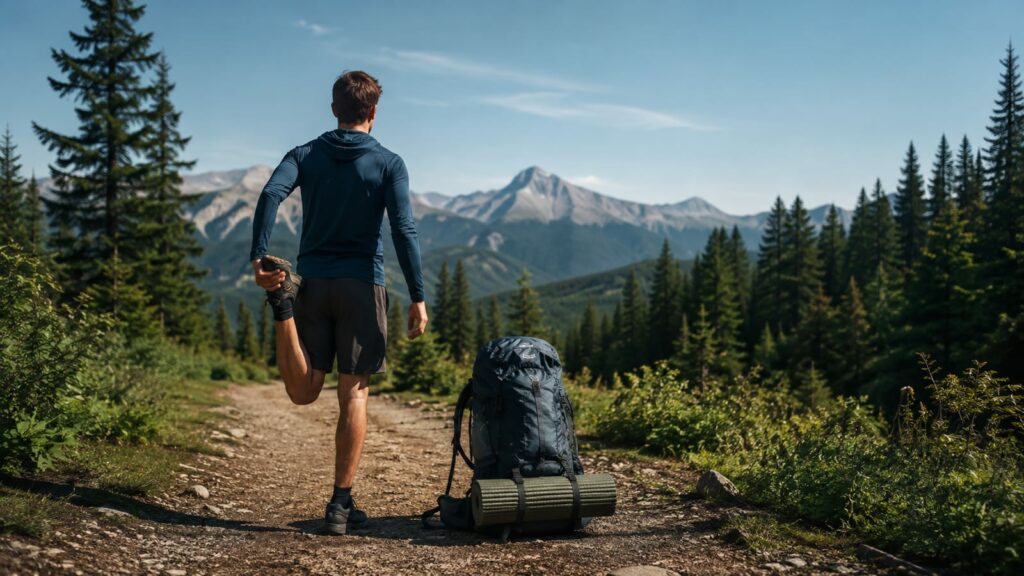
Most trailhead stretching is wasted motion. The backpacking stretches worth your time are a short dynamic warm-up before you walk (leg swings, ankle circles, walking lunges, trunk rotations), quick standing resets at breaks for calves, hips, and chest, and slower static holds for hips, quads, hamstrings, and calves once camp is up and your body is still warm. Aim at ankles, calves, hips, quads, and upper back, because those tissues carry the load. Never stretch through sharp pain, and don't chase flexibility on tired legs at the edge of a rocky slope.
Do you actually need to stretch before hiking?
You need a warm-up. You don't need the long hold-and-breathe routine people run in the parking lot while their pack sits in the dirt.
Cold muscle under a loaded pack is stiff and slow to respond. A few minutes of movement raises tissue temperature and wakes up the hips and ankles before the trail asks for them. Long static holds do the opposite job at the wrong moment. They leave you feeling loose and vague right when you want your feet reporting back accurately.
The toe-touch at the trailhead is a habit dressed up as preparation. Move the joints instead, then walk the first easy stretch of trail slowly and let that finish the job.
The pre-trail warm-up that earns its few minutes
Do this with the pack off, then shoulder it and go. Keep every move small and controlled.
- Ankle circles and calf pumps. Roll each ankle both ways, then rise onto your toes and drop your heels a few times.
- Leg swings, front to back and side to side. Hold a tree or a trekking pole. Let the leg swing instead of kicking it.
- Walking lunges with a reach. Step forward, sink gently, reach the opposite arm overhead. This hits hip flexors and upper back at once.
- Standing quad pull. Grab the ankle, keep the knees together, stand tall instead of arching your back.
- Hip circles. Lift one knee to hip height and draw slow circles outward, then inward.
- Arm circles and shoulder rolls. Small first, bigger after.
- Trunk rotations. Feet planted, turn your ribs left and right without twisting the knees.
Then put the pack on and roll your shoulders a couple of times under the straps. Your shoulders load differently once the weight is there.
If your knees complain from the first step, warm-up moves for aching joints are worth working through at home before the trip.
Break-time resets that don't cost you daylight
Stay standing and keep it short. A long sit in wind means starting cold again, and cold restarts on tired legs are where sloppy steps come from.
Lean your hands on a boulder or a tree and drop one heel back to open the calf. Prop a foot on a low rock for a soft hamstring stretch with a flat back. A standing figure-four, ankle crossed over the opposite knee, hits the glute that gets angry on long climbs.
For the upper body, unclip the hipbelt and let the pack settle on a rock behind you. Shrug your shoulders backward a few times. Resting a forearm against a tree trunk and turning away opens the chest nicely.
Two rules for break stretching. Nothing that needs balance you don't have on that ground, and nothing that takes so long you stiffen up.
Lower legs, feet, and ankles take the real abuse
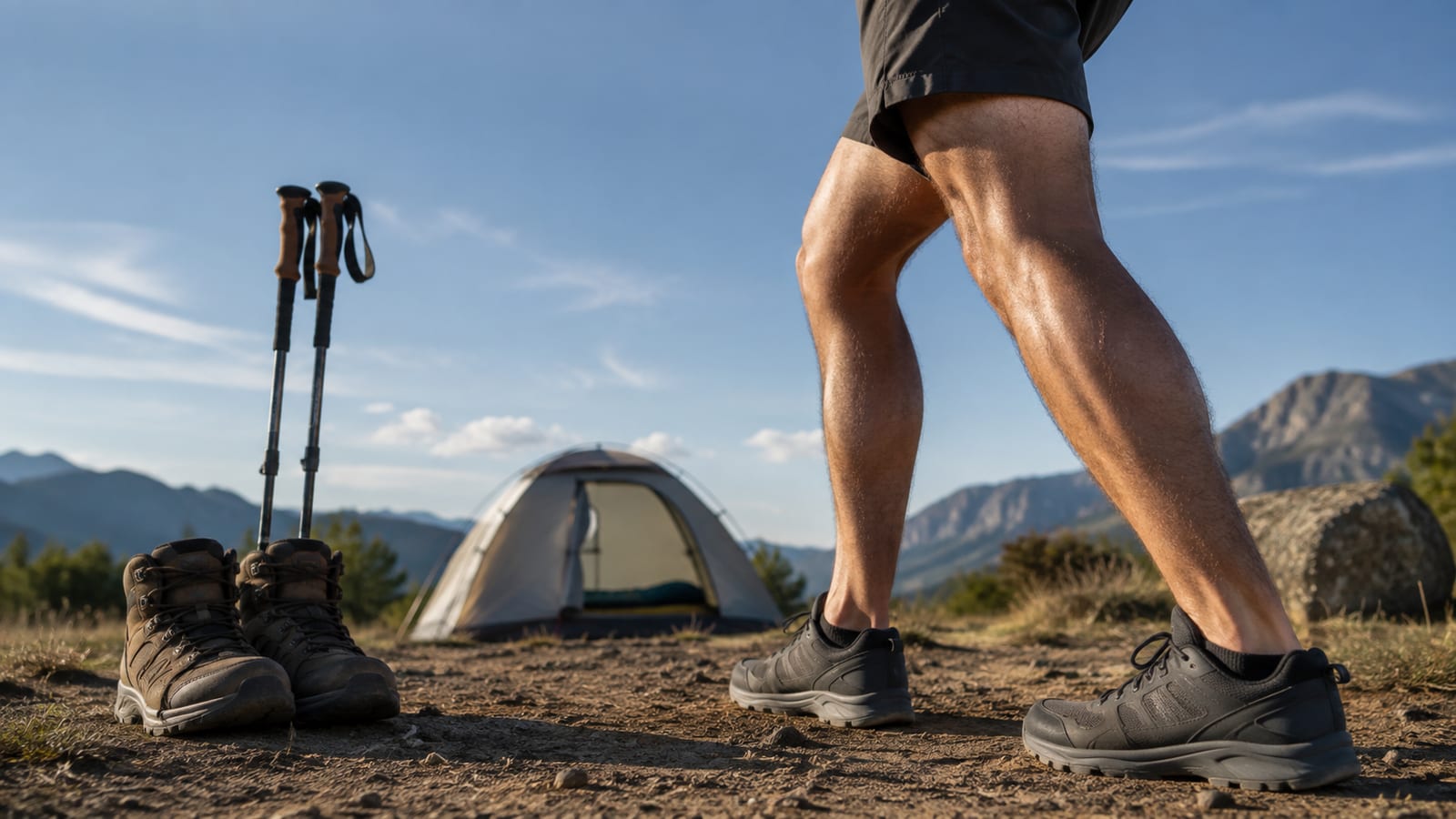
Climbing loads your calves. Descending loads them harder, because they're braking every step under pack weight.
Stretch the calf two ways. A straight back leg with the heel down gets the big surface muscle. The same position with the back knee bent gets the deeper one underneath, which stays tight on steep days.
Ankle mobility matters more than most hikers think. Kneel with one foot flat and drive that knee forward over the toes. If the heel lifts early, your ankle is stiff and your foot will compensate on uneven ground.
Feet get skipped almost every time. At camp, pull your toes back gently to stretch the arch, spread them with your fingers, and roll the sole over a smooth rock or a full water bottle.
Toe cramps on descents usually come down to fit and pacing. Tightness just gets the blame. Snug lacing over the midfoot and a smoother walking rhythm on long trails fix more of them than any stretch will.
Hips and quads under a loaded pack
Hip flexors get short on climbing days and shorter on days you sit around camp early. A hipbelt riding on your pelvis all afternoon doesn't help either.
Half-kneeling is the best option if you have a sleeping pad or a soft patch of ground. Back knee down, squeeze the glute on that side, tuck the pelvis under, then lean forward slightly. You should feel the front of the hip. If you feel it in your low back, you've gone too far.
For quads, keep the standing pull gentle. Yanking a heel toward your backside on a tired knee irritates the kneecap, and the extra range buys you nothing on trail.
Glutes respond well to a figure-four, standing at breaks or lying on your back at camp. Hamstrings deserve caution. What feels like a tight hamstring is often a cranky low back or nerve, so ease in and stop if the sensation is sharp, buzzing, or travels down the leg.
Loosening a stiff back and shoulders
Pack stiffness lives mostly in the mid-back, the chest, and the neck you've been craning to watch your feet.
Try these, in this order:
- Seated or standing rotations. Hands on the pack straps, turn the ribs one way, then the other.
- Overhead side bend with a trekking pole. Hold the pole wide, reach up, lean sideways without folding forward.
- Chest opener. Forearm on a tree, turn your body away until the front of the shoulder opens.
- Chin tucks. Draw the chin straight back, no nodding. This resets the neck after hours of looking down.
- Scapular squeezes. Pull the shoulder blades together and hold for a breath.
Learn the difference between stiffness and a warning. Aching between the shoulder blades is normal after a loaded day. Numbness or pins and needles in the hands is a pack problem: straps too tight, torso length wrong, or too much weight on the shoulders instead of the hips. Fix the pack, because no amount of stretching outruns bad load carriage.
Which backpacking stretches help most after camp is set?
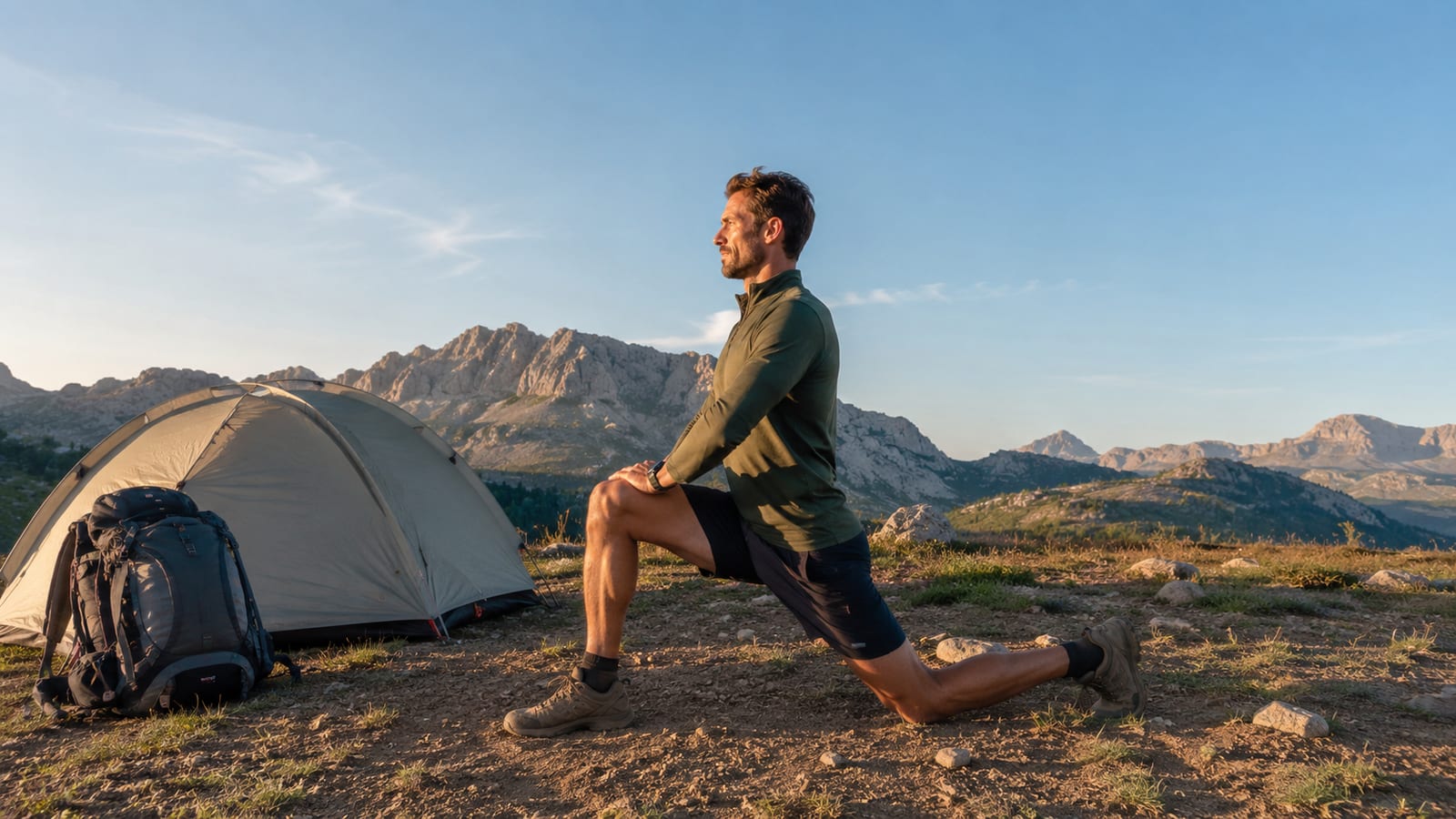
Static holds finally make sense here, once the tent is up and the day's walking is done. Your body is warm, the ground is flat, and nothing after this needs quick reflexes.
Do them before you get cold and before a big dinner. Lie on your pad and run a supine figure-four for the glutes, a side-lying quad stretch, a hamstring stretch with a spare strap or a guyline hooked around the foot, and a calf stretch against a tree. Add child's pose for the low back if the ground is dry.
Hold each one long enough for the tissue to give, breathing normally, without bouncing. Then get in a layer.
Sore, not injured, is the target. For the broader picture on eating, sleeping, and easing back into it, a proper post-trail recovery plan does more for the next day than any single stretch.
Can stretching prevent hiking injuries?
Not really, and anyone selling it that way is overselling. Stretching buys you comfort and usable range of motion. It does not armor your knees.
What actually lowers your injury risk is duller. Carry less, walk within your fitness, get a pack that fits, wear footwear that suits the terrain, and eat and sleep enough to keep your form together late in the day. Strength work matters more than flexibility for load carriage, and the Physical Activity Guidelines for Americans give a sane baseline for how much to do.
Build that before a trip with a structured thru-hike training plan. The week you leave is too late.
Most trail injuries come from fatigue and a bad step, not from short hamstrings.
Stop rules: when stretching is the wrong move
Stop and reassess if you get sharp or stabbing pain, pain that worsens as you hold, swelling, bruising, numbness, a joint that gives way, or a pop at the moment something went wrong.
Stretching a strained muscle turns a two-day problem into a two-week one. A suspected sprain or strain wants rest and protection first, and the sprains and strains overview from the National Institute of Arthritis and Musculoskeletal and Skin Diseases describes plainly what you're dealing with.
On trail, this is a decision point. If you can't bear weight, if the joint feels unstable, or if symptoms keep escalating, head for your bailout point and get it looked at.
Deep calf pain with swelling in one leg, chest pain, or numbness that doesn't resolve means medical help, not a hold-and-breathe.
Building it into a multi-day routine
Attach the stretching to things you already do, or it won't happen. Boots on means warm-up. Pack off means reset. Tent up means hold.
| Timing | What it's for | Worth doing | Skip |
|---|---|---|---|
| Before walking | Wake up joints, raise tissue temperature | Leg swings, ankle circles, lunges, trunk rotations | Long static holds, deep hamstring work |
| Breaks | Relieve the spots the pack loads | Standing calf, figure-four, chest opener, shoulder rolls | Anything needing balance on loose ground |
| Camp | Recovery and range of motion | Static holds while warm, foot rolling, hip flexors | New, aggressive positions you've never tried |
On a long route the mornings compound. The John Muir Trail, in California's Sierra Nevada, extends for more than 200 miles from Yosemite Valley to the summit of Mount Whitney and passes through Devils Postpile National Monument. By the second week, your ankles decide how the day goes. The Wonderland Trail, circling Mount Rainier in Washington, punishes calves and quads instead with relentless climbing and descending.
Keep it simple. A few minutes at three fixed points in the day beats a perfect routine you abandon on day three.
FAQ
Do stretches stop leg cramps on the trail?
A stretch gives short relief, and that's about it. Cramps usually track back to fatigue, heat, low food, or a pace your legs didn't sign up for. Ease off, drink, eat something salty, and stretch the cramping muscle gently while it settles. If cramps hit on the same climbs every time, look at training and pacing before you add more stretching.
Is a foam roller worth the pack weight?
No. Leave it in the car. A smooth rock, a full water bottle, or a tent stake pressed into the arch of your foot covers the same ground for zero weight. A small massage ball is the one exception if you have a known trouble spot and you'll actually use it.
How do I handle cold, wet mornings?
Move before you stretch. Layer up, walk around camp, do a few ankle rolls and arm circles under your rain shell, then start walking slowly and let the trail warm you. Standing moves only, since kneeling in wet duff soaks your knees for nothing. Save anything on the ground for a dry afternoon.
Should I stretch on a rest day?
Light movement beats a long stretching session. Walk a little, do easy hip and calf work, and keep the joints moving without adding fatigue. A full day off your feet capped by a stretching marathon tends to leave you stiffer. If you plan rest days into a trip, a training schedule built for thru-hiking is a better place to work out the pattern than guessing on trail.
