
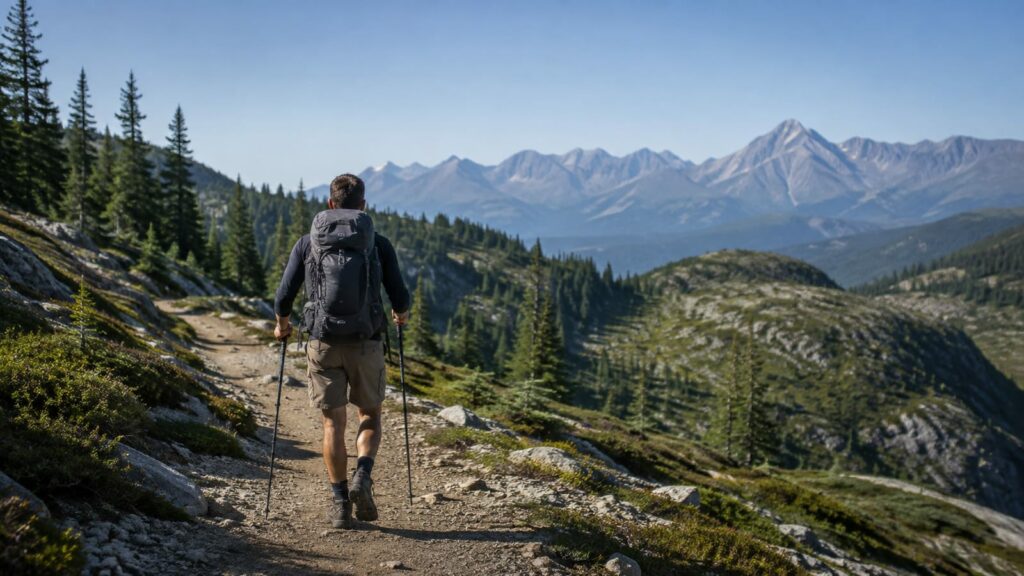
No, walking faster is not the main goal on a marked hiking path. The useful options are steady pacing on clear tread, slower steps at junctions, and deliberate foot placement on rough ground. The goal is staying on the tread, reading junctions correctly, and placing each foot where it will hold. Even on the Pacific Crest Trail, which runs 2,650 miles from Mexico to Canada, steady movement matters more than rushing. Chase pace first and you miss markers, cut switchbacks, roll an ankle, and finish later than the hiker who kept looking.
Last updated: 2026-09-24
Stay on marked hiking paths with steady pacing, careful foot placement, smart navigation, and practical advice for junctions, heat, and rough ground.
Walking with purpose beats walking fast
Efficient hiking means steady progress, controlled effort, and stable balance. Your task is to move well for the whole route, not chase speed for one mile. You are trying to avoid the small mistakes that leave your feet, knees, and shoulders angry after mile 10.
Every step should solve a small problem. This rock is flat. This line stays on the tread. This pause gives you time to read the junction ahead. Speed does not improve those choices. It only makes poor ones arrive sooner.
A heavy pack makes every mistake harder to hide. Fix your pacing and foot placement before spending money on new shoes.
Where speed helps and where it costs you
Staying on a marked path requires your eyes to read the ground under you and the route ahead. Push the pace and the near ground usually wins. That is when you miss a blaze, walk past a turn, and lose time backtracking.
There is a useful kind of faster. Move briskly on smooth, obvious tread when you need to bank daylight. Slow down at a faint junction, on loose rock, and anywhere the trail disappears into grass. Moving fast through those sections is how a walk turns into an unplanned bushwhack.
| Situation | Speed helps | Speed costs you |
|---|---|---|
| Smooth, wide, well-marked tread | Yes, bank the daylight | Little |
| Rocky or rooty sections | No | Ankles, toes, balance |
| Trail junctions and faint tread | No | Wrong turns, backtracking |
| Long descents | No | Knees, blisters, control |
| Heat, late afternoon, low water | Sometimes, to reach shade or a source | Judgment goes first |
What efficient long-distance walking looks like
Efficient walking looks calm. Your steps stay short enough to control, your breathing stays regular, and your body does not lurch from side to side. You should finish a stretch of trail feeling like you could keep going.
If your shoulders are tight, your feet slap the ground, or you keep braking downhill, your form is costing energy. The fix is usually simpler than new gear:
- Short, steady steps
- Foot placement under or near your body
- Soft knees on uneven ground
- A level gaze that scans ahead
- Arms that help with balance
- A pace you can repeat after breaks
- Small adjustments instead of sudden corrections
- Enough food and water to prevent sloppy movement
The goal is not perfect form. Trails are too uneven for that. You can still make fewer expensive movements on climbs, loose rock, roots, and long descents.
How to walk correctly for longer trekking
Start with a short stride and a pace you can hold for hours. Then practice that movement under pack weight and fatigue. A strong trail pace comes from repetition, not from turning every walk into a test.
Scan the trail before you step
Look several steps ahead instead of staring at the patch of ground under your shoes. Pick a clean line through rocks, roots, mud, or loose gravel. Keep shifting your eyes between the near trail and the route farther ahead.
If you only watch your toes, you react late. Late reactions create longer steps, awkward twists, and sudden stops.
Choose a line and make small corrections
Pick the smoothest practical path, then stay with it. You do not need to dodge every pebble like it insulted your family. Small corrections keep your hips and shoulders quiet.
Veering across the trail adds distance and forces your legs to push sideways. On switchbacks, follow the actual trail instead of cutting corners. Shortcuts damage the ground and leave you on loose dirt where each step is less secure.
Stack your posture
Keep your head, ribs, hips, knees, and feet generally aligned. Stay tall without becoming stiff.
- Keep your gaze level and your chin relaxed.
- Keep your shoulders down and your torso over your hips.
- Bend your knees slightly.
- Let your arms swing without clenching your fists.
- Lean forward from the ankles on a climb, not from the waist.
A rigid military posture adds tension under your pack and makes breathing feel cramped. Lock your arms against your sides and your legs handle every correction alone.
Shorten your stride before the hill does it for you
Long steps feel productive on flat ground. On a climb, they become small lunges that pull at your calves and hips. Shorten your steps as the grade rises, and stop pushing before your breathing goes ragged.
On a descent, short steps keep you over your feet and reduce the braking force sent into your knees. Keep your feet light and compact while clearing rocks and roots. For more on downhill travel, our guide to descending steep trails without injury covers the rest.
Place each foot deliberately
Aim for secure contact rather than a certain part of the foot. Forcing a forefoot landing on rocky ground overloads your calves and makes balance worse. Place your foot where it can stay stable, as flat as the surface allows, and close to your hips.
Good foot placement means you see the landing spot before committing. Your foot lands quietly, your ankle stays controlled, and your knee stays soft. Skip unstable rock edges. Stop kicking roots and dragging your toes.
Quiet steps give you useful feedback. Loud footfalls usually mean you are landing hard, overstriding, or letting fatigue drive. For rocky ground, these rocky trail footwork techniques go deeper.
How can you keep a straight path on a trail?
Keep a straight hiking path by scanning ahead, choosing a line, and making small steering changes. Do not wait until you are far off course before correcting.
- Look ahead for the trail's clearest continuation.
- Choose a nearby point to walk toward.
- Keep your chest and hips pointed along that line.
- Check a farther landmark before the near one disappears.
- Correct gently if the trail bends or the surface changes.
Your feet follow your hips. If your eyes point one way while your shoulders point another, you will drift and then overcorrect. This matters most on open trails, sandy ground, broad ridgelines, and forests where the tread is faint.
At a junction, stop long enough to confirm the direction. A rushed wrong turn costs more time than a short pause. If the trail disappears, check your map and return to the last place you knew you were on route.
Landmarks that actually work
Use both near and distant landmarks. A nearby rock, bend, or tree handles your next stretch. A ridge, saddle, or visible trail cut confirms the larger direction.
At trail junctions, confirm:
- Which branch matches your map
- Whether the trail marker faces your direction
- Whether the tread continues after the turn
- Whether your route follows a ridge, drainage, or contour
- Whether a side path leads to parking, water, or a campsite
Avoid landmarks that can move or vanish. A person, animal, cloud shadow, or leaning sign is not a navigation plan.
Recheck your landmarks after every long break. People leave a rest spot facing the wrong way constantly, especially where the trail splits near water or a viewpoint.
Efficient hiking trails reward steady pacing
The most efficient trails are often boring by design: graded tread, consistent surface, switchbacks instead of straight-up fall-line climbs, and markers visible from the last one. Rail-trails, canal towpaths, and well-built national scenic trail sections fit. You can hold one rhythm for hours without arguing with the ground.
The Pacific Crest Trail is a clear example of a trail built for sustained walking. Its long, consistent grades let hikers cover distance through steady effort. Big days come from repeatable movement, not heroics.
Trails that punish pacing look different: cobbled New England-style rock, sandy desert washes, blowdown-heavy logging country, and anything with a fall-line climb. You can still hike them well. Plan fewer miles and stop pretending your flat-ground pace transfers.
If you want even effort, check the elevation profile before the mileage. A flat day and a lumpy day with the same distance are different trips.
Optimizing hiking trails for navigation and safety
Trail planning starts before you leave the trailhead. Pull the land manager's current map, check closures and reroutes, and note where the tread is faint. Most wrong turns happen at spots you could have flagged from your couch.
On the ground, these habits do the heavy lifting:
- Note your last confirmed point every time you pass a junction or bridge.
- Set a turnaround time, then keep it even when the weather looks fine.
- Mark bailout points where the trail meets a road or shorter loop.
- Load offline maps before you lose signal, and carry a paper backup.
- Watch for reroutes around washouts, because old tracks stay visible for years.
The gotcha nobody mentions is the social trail. A well-worn path to a swimming hole or viewpoint often looks more used than the real route. Trust your map and the official markers over the dirt.
Volunteer trail maintenance keeps the markers honest
The reason you can follow a trail at all is that someone cut the corridor, painted the blaze, and cleaned the drainage. Much of that work comes from volunteers. Trail crews with the USDA Forest Service and local clubs handle brushing, tread repair, and blowdown removal on ground agencies cannot reach with paid staff.
Do one work day and your navigation improves permanently. You learn what a sight line is, why blazes sit at eye level on the approach side, and how water destroys tread when a drain clogs.
Bring gloves, long pants, real shoes, a packed lunch, and more water than you think. Some crews provide lunch; assume they do not. Crews may also set a harder pace than a day hike.
Gear and health: what earns its place
Gear does not fix pacing or foot placement. A few items genuinely help you stay on the path, though, and most are cheap.
- Shoes that fit your footbox and lock your heel. Blisters wreck your steps before your legs do.
- Socks that do not bunch, plus tape for a known hot spot.
- A paper map and compass, with enough practice to use them once.
- A headlamp, every time, even for a short loop.
- Salty food you can reach without unpacking your whole bag.
Health practices matter more than any of it. Sleep, water, and calories keep your judgment working. Judgment is what keeps you on the tread. A hiker running on one granola bar makes careless steps and worse route calls.
Skip the compression gear, the electrolyte powder marketed for performance, and anything promising effortless miles. That sounds better on a hang tag than on a climb. If fatigue is the problem, these tips to avoid fatigue during long hikes are more useful than another purchase.
How to choose trail books and videos
Choose a navigation book over a technique book. Walking form takes one article and a hundred miles of practice. Map, compass, and terrain reading take real study, and a good wilderness navigation manual pays you back for decades.
For video, land manager and search-and-rescue channels beat hiking influencers. Look for agency videos on route finding, river crossings, and trip planning. They are dry and correct, which is useful when the route is wet and the map is confusing.
Anything advertised as a system for faster hiking deserves a hard look. Ask whether the advice changes what your feet do on a rocky descent. If it does not, close the tab.
Trail conservation projects and why cutting corners matters
Every switchback shortcut you take becomes a channel for water, and water takes the tread with it. A clear path turns into a braided mess where nobody can tell which line is real. Staying on the marked route is conservation work you do for free.
Conservation projects fund reroutes, drainage, and hardening that keep trails followable. Adopt-a-trail programs, erosion repair, and invasive plant removal all show up in your hike as tread you do not have to guess at.
Practical version: walk through the mud puddle, rather than around it. Widening trails is worse than wet shoes.
Outdoor calendar events for real trail conditions
Local hiking club calendars and land manager event pages are the fastest way to learn current conditions. Trail work days, group hikes, and seasonal skills clinics bring people who walked the route recently.
Shoulder-season events are the useful ones. Snow lingers on north slopes, creek crossings run high, and last year's blowdowns may still be in place.
Go to one club hike before a big trip. Ask about water, parking, and which junctions confuse people. Ten minutes of that beats an hour of reading.
Choosing a pace you can hold
Start slower than your excited brain wants. The first climb is where many hikers spend energy they will need later. Use the talk test: you should be able to speak in short sentences without gasping.
Breathing is a useful check, not a rule carved into a trekking pole. Heat, humidity, altitude, pack weight, and poor sleep all change your effort. Adjust for the conditions instead of defending a pace from last weekend.
Take breaks before you are wrecked. A short stop for water, food, or a sock adjustment can prevent a longer stop later. Plan practical pauses around:
- Water carries
- Exposed heat
- Steep climbs
- Long descents
- Trail junctions
- Shaded spots
- Pack rub or hot spots
- Weather changes
Food and water are part of walking technique. A low tank makes your stride shorter in the wrong way, your balance worse, and your decisions slower.
Building fitness for long trails
Build a regular walking base before adding hard trail days. Your body improves through repeated time on feet, not one punishing outing followed by several days of soreness.
A useful progression:
- Easy walks on smooth ground
- Longer walks at a relaxed effort
- Hills at a controlled pace
- Uneven surfaces for balance
- Pack practice with the load you expect to carry
- Recovery walks that leave you fresher afterward
Do not make every walk a test. Easy mileage teaches your body to move efficiently without constant strain. If you are aiming at a long trail, this guide to training for a thru-hike lays out the build.
Who this is for, and who should skip it
This approach fits anyone hiking more than a few miles: day hikers on rocky ground, backpackers under load, and hikers with knees that notice descents. It also fits people who keep getting lost on faint tread.
Trail runners and racers have a different problem. If your goal is a time, you are trading accuracy for speed on purpose, and you should be doing it on tread you already know.
Skip the fussing if your hike is a flat, paved two-mile loop. Walk however you like and enjoy it.
FAQ
Does hiking slower burn more energy overall?
Slower walking uses less energy per minute but more minutes, so total burn often lands in a similar range on day hikes. The larger difference is what you have left at the end. Controlled movement keeps your legs useful for the descent, where tired hikers make expensive mistakes.
Why can another hiker's pace fail on my route?
Pace depends on trail grade, surface, pack weight, water carries, heat, and your own conditioning. A strong pace on smooth tread may collapse on loose rock or a steep descent. Use another hiker's time as background information, then plan around the conditions you will actually face.
What should I do the moment I realize I am off the marked trail?
Stop moving forward. Look for the nearest blaze or cairn from where you stand, and if you cannot see one, backtrack to your last confirmed point. Walking downhill toward a road works in stories and gets people cliffed out in real life.
Do trekking poles help me stay on the trail?
They help on loose rock, stream crossings, and steep descents where balance is the limiting factor. On smooth tread they mostly give your hands something to do. Poles support your steps, but they cannot read a junction for you.
Is walking faster ever the right call?
Yes, when weather is closing in, daylight is running short, or you need to reach water. Speed up on ground you can read, then slow down at junctions and rough sections. That is a deliberate tradeoff, rather than a default.
