
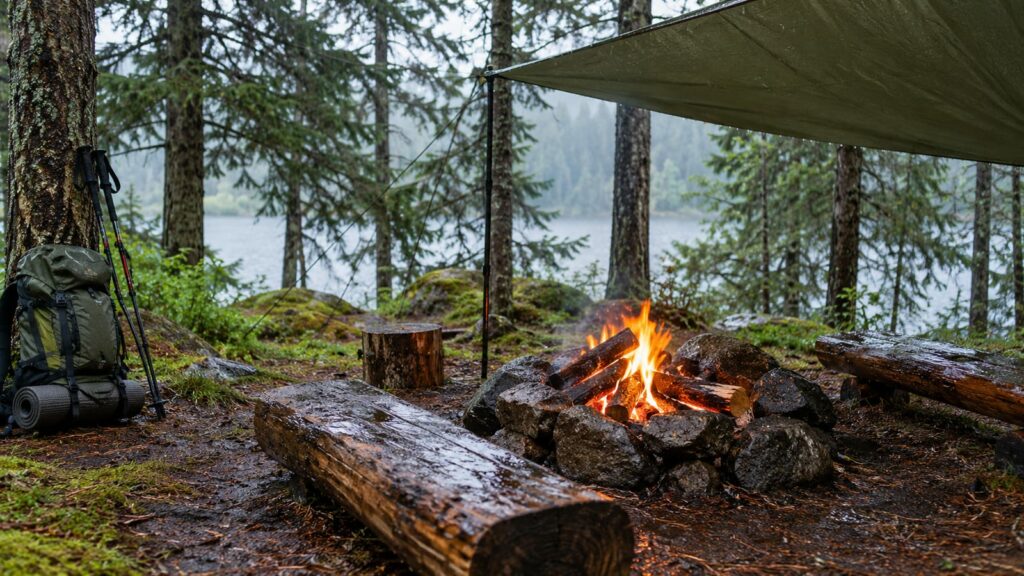
A wet-weather fire is mostly a prep job, and most of these fires fail before anyone strikes a match. To start a campfire in wet conditions, confirm fires are legal first. Then light a dry tinder core you carried in, feed it split dead wood from the dry inside of local branches, and keep the fire small on bare ground or an existing ring. When you're done, drown it until the ashes are cold.
If there's a burn ban, strong wind, rising water, or nothing around but soaked green wood, skip the fire and cook on the stove.
Check fire rules and the weather first
Rain at camp does not mean fires are allowed. Bans are set for whole regions, and they often stay in place for days after a storm passes. So check the land manager's current fire rules before you gather a single stick, whether that's a national park, national forest, state park, or private campground. A ranger at the entry station usually knows more than any app.
Rules also cover more than yes or no. Many places limit how big a fire can be or where it can sit. For example, Cape Hatteras National Seashore in North Carolina caps beach fires at 3 feet across. Other sites allow fires only in metal rings, or only below a certain elevation.
Then look at the actual weather. Skip the fire if any of these apply:
- Gusty wind that throws sparks past the ring
- Thunder close enough to hear, which makes it a night for shelter
- Rising water, or a site in a wash or on a low creek bench
- A fire ban, a red flag warning, or a ranger telling you no
A stove boils water in all of those conditions. The fire can wait for a better night.
Pick a site that can take a fire
Use an established fire ring when there is one. It already sits on scorched ground, it keeps damage in one spot, and rangers expect fire there. Building a fresh ring next to an existing one is a habit worth dropping.
Distance matters more than people expect. Great Smoky Mountains National Park says campfires should sit at least 15 feet from anything else on the campsite, and that's a sane default anywhere the rules don't say otherwise. That includes tents, tarps, packs, and low branches overhead.
Cold, wet weather tempts people to tuck the fire close to the tent. However, nylon melts long before it catches, and a single ember can hole a rainfly. If you camp near fires a lot, it helps to know what fire-resistant tents can and can't handle.
Avoid low spots, too. In rain, the ring at the bottom of a slope collects water and turns into ash soup. Pick a ring on slightly higher, well-drained ground with some cover from the wind.
Clear the ground and move your gear
Rake leaves, needles, and grass away from the ring down to bare soil or rock. Wet litter on top can hide dry layers underneath that smolder for hours. Snap off or tie back low branches over the fire. Then scoop standing water and soggy ash out of the ring, so your tinder isn't starting in a puddle.
Next, move your stuff. Packs, rain jackets, sleeping bags, and fuel canisters belong well outside the fire's reach. Drying socks on a stick over the flames ends with a melted heel more often than a dry sock. Instead, hang wet clothes where warm air reaches them, well back from the sparks.
Our guide to low-impact campfire habits covers ring etiquette and cleanup in more detail.
Where do you find dry fuel after rain?
Look up, not down. Ground wood soaks water like a sponge and is often half rotten. Meanwhile, standing dead branches and the thin dead twigs on the lower trunks of conifers stay much drier, because water runs off them. If a twig snaps cleanly with a crack, it will burn. If it bends or feels spongy, leave it.
Good natural tinder in wet woods:
- Birch bark, which holds oils that burn even when damp
- Fatwood, the resin-soaked core of old pine stumps and knots, easy to spot by its sticky amber color and turpentine smell
- Dry inner bark from dead branches, shredded fine
- Dead conifer twigs, thinner than a matchstick
Still, don't count on finding any of that. Carry a dry tinder core in a zip bag: cotton balls smeared with petroleum jelly, fire starter cubes, or a wad of dry shavings from home. Pack two ways to light it, such as a lighter in an inside pocket and a ferro rod. Lighters get fussy when cold and wet, while a ferro rod still sparks after you wipe it on your shirt.
Collect only what the rules allow. Most parks permit dead and down wood near camp and ban cutting live trees. Never haul firewood from home to a distant camp, because it can carry tree-killing insects and disease. Gather or buy wood locally, which is often the rule anyway.
Split wet wood to reach the dry core
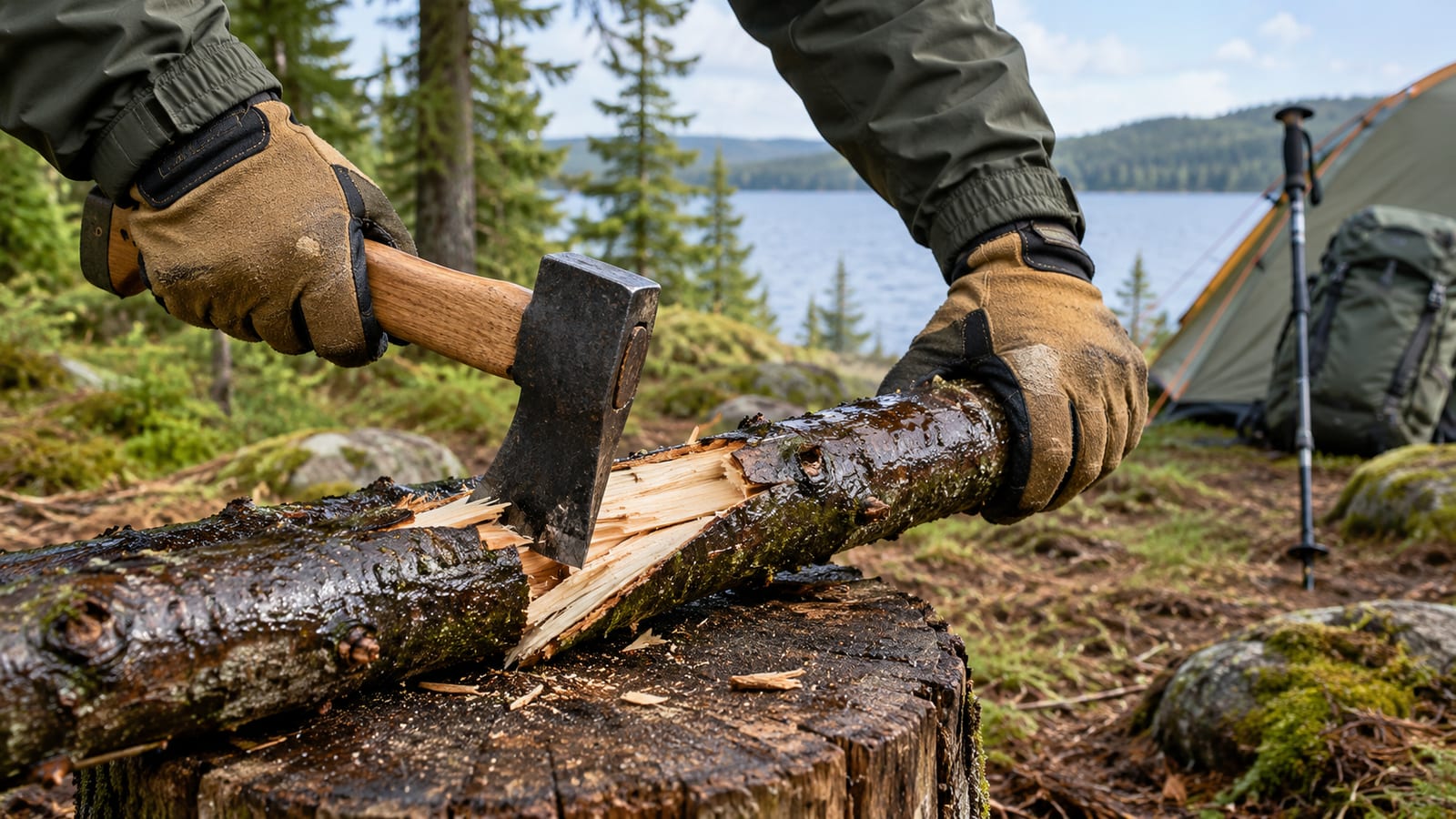
Rain soaks the outside of dead wood quickly and reaches the middle slowly. As a result, splitting decides most attempts to start a campfire in wet conditions. The EPA's Burn Wise program says properly dried firewood should read 20% moisture or less on a meter. You won't carry a meter, but the idea holds: seasoned dead wood stays dry inside, and the wet surface is a thin problem.
Green wood is different. It's wet all the way through, and no amount of splitting fixes that.
Use a fixed-blade knife, a small folding saw, or a hatchet. Saw dead branches to forearm length, then split them by tapping the knife's spine with a second stick. That's called batoning. Shave a few pieces into feather sticks, which are thin curls left attached at one end. They catch faster than loose shavings and don't blow away.
Sort everything into piles before you light anything:
- Tinder: your carried core plus fine curls and shavings
- Small kindling: pencil-lead to pencil-thick splits
- Large kindling: thumb-thick splits
- Fuel: wrist-thick splits, dry side facing out
Make each pile about twice as big as seems reasonable. The worst moment in a wet fire is leaving a weak flame to hunt for more kindling.
Build a small, sheltered fire lay
Start with a platform. Lay a row of wrist-thick splits across the ring, dry side up, so your tinder sits off the wet soil. Damp ground pulls heat from the bottom of a small flame, and it kills more wet-weather fires than falling rain does.
Put the tinder core on the platform. Then lean small kindling over it in a tight teepee. A teepee sheds drizzle and pulls air up through the center. Leave a gap on the upwind side so you can reach in to light it.
Keep the larger kindling and fuel close but covered, under a jacket, a pack cover, or a slab of bark. For a windbreak, use a boulder, a log, or your own body crouched on the windward side.
Don't light under your tarp. Any tarp low enough to keep rain off the tinder is low enough to catch a spark.
How do you start a campfire in wet conditions?
Once the site is clear and the piles are ready, lighting takes a few minutes. Work in this order:
- Check one last time that gear, fuel canisters, and the tent sit well clear of the ring.
- Crouch upwind of the fire lay so your body blocks wind and rain.
- Light the tinder core low, near the base, from the upwind side.
- Let the flame climb into the tinder for a few seconds before adding anything.
- Add the thinnest kindling one or two pieces at a time, laid across the flame.
- Move up to pencil-thick, then thumb-thick splits once the small stuff burns on its own.
- If the flame stalls, blow gently and low, aimed at the glowing base.
- Add wrist-thick fuel only once glowing coals sit under the kindling.
The classic failure is doing step 8 at step 4. A big wet log on a small flame acts like a lid. It soaks up heat and smothers the fire before the kindling ever caught.
Feed it slowly and keep it small
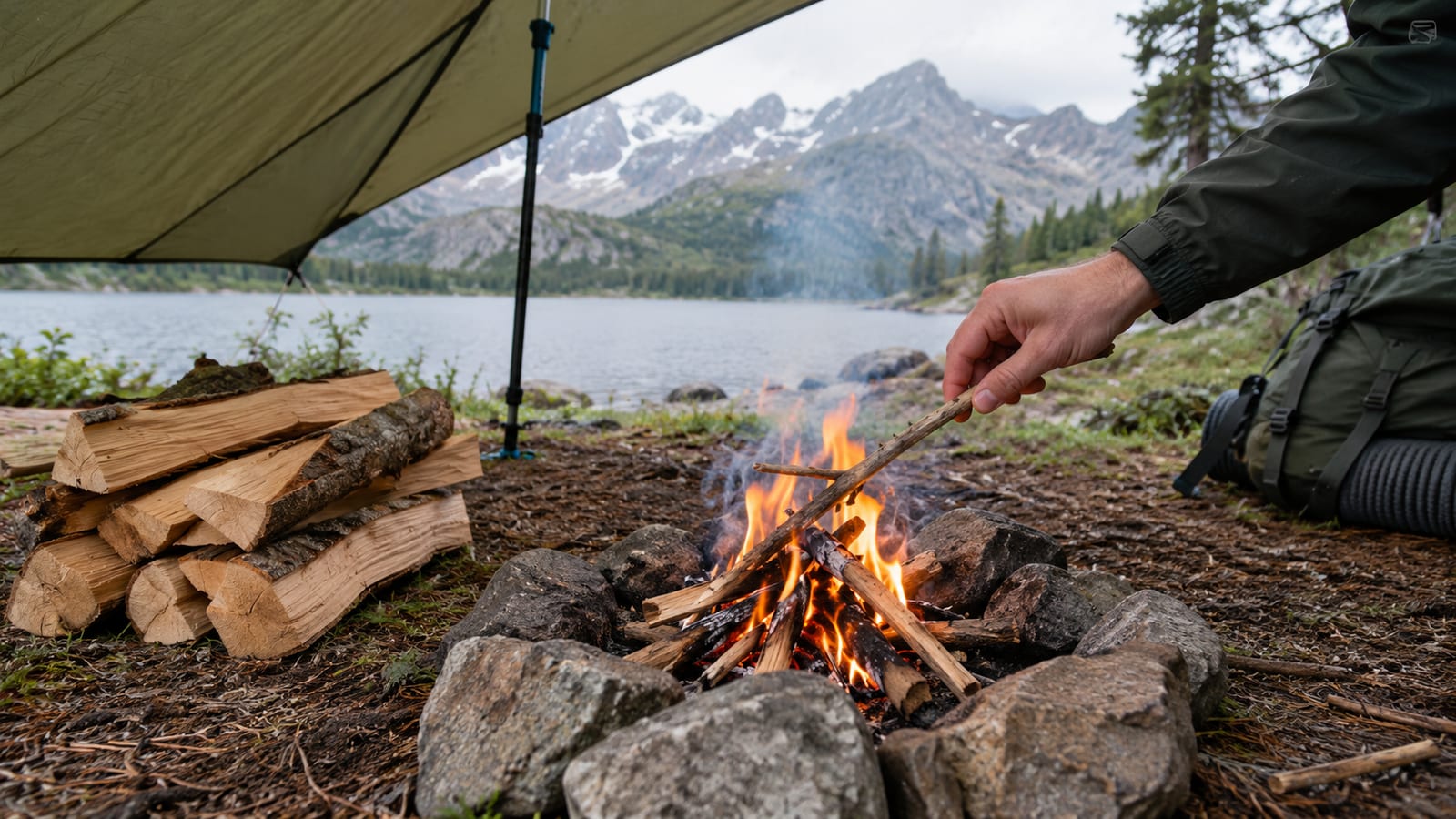
A small fire is easier to keep alive in rain than a big one, and it's easier to put out. Add one or two dry-surfaced splits at a time, and wait until each catches before adding more. Meanwhile, stand a few pieces upright around the outside of the ring. Close enough to feel warm, far enough not to catch, they'll steam off surface water before they go in.
Keep the fire inside the ring and within any size rule. Watch which way sparks drift, then clear anything flammable out of that path. If the wind picks up enough to carry embers past the ring, let the fire burn down.
Never use gasoline, white gas, stove fuel, or aerosol sprays to help a wet fire. Liquid fuel turns to vapor and flashes back toward whoever is pouring it. By contrast, petroleum jelly cotton balls and fire starter cubes burn slowly and stay put, so they're fine.
Why is my fire smoking and dying?
Heavy white smoke means water is boiling out of the wood faster than the fire can burn it. Most weak wet-weather fires trace back to one of four problems, and a bigger log fixes none of them.
| What you see | Likely cause | What to do |
|---|---|---|
| Thick white smoke, little flame | Wood too wet or too big | Split smaller, add drier pieces |
| Flame dies when you add wood | Fuel added too fast | Pull back big pieces, rebuild with kindling |
| Tinder burns out, kindling won't catch | Kindling too thick | Shave more feather sticks, go thinner |
| Coals glow but keep fading | Poor airflow or a wet base | Lift the lay onto a platform, blow gently |
If rain keeps hitting the core, move the tinder under better cover or build a taller windbreak. Often the fix is shelter rather than more fuel.
Know when to quit. If you've burned most of your carried tinder and nothing holds, the wood can't support a controlled fire. Put it out and use the stove. When you're soaked and cold, dry layers, a hot drink, and your sleeping bag warm you faster than a sulking fire, and our guide to preventing hypothermia on cold hikes covers that order of operations.
Put it out until it is cold
Rain will not put out your campfire for you. A wet crust of ash can sit on top of coals that stay hot underneath for hours. So treat a fire in drizzle exactly like one on a dry night.
- Stop adding wood well before bed or departure, so the fire burns down to ash.
- Drown the coals with several full pots of water.
- Stir the ash and coals with a stick, and scrape embers off partly burned wood.
- Drown everything again.
- Hold the back of your hand just above the ash. If you feel heat, repeat steps 2 to 4.
- Keep going until there's no hissing, steam, smoke, or glowing ember.
Before you leave, pack out anything that didn't burn and leave the ring the way local rules ask. Some areas want cold ash scattered, while others want it left in the ring.
Hoping for coals in the morning is a separate job with its own rules. See our guide to banking a fire overnight, and confirm your campground allows unattended coals at all.
FAQ
Does birch bark really burn when it's wet?
Usually, as long as you strip it thin. Shake off standing water, peel the bark into fine strips, and fluff them into a loose pile. A thick slab mostly smokes and curls tighter in the heat. Take it only from dead or fallen trees, since peeling live birch scars the trunk and can kill the tree.
Is it OK to burn food scraps or trash in a weak fire?
No. A cool, wet fire leaves food half-charred, which is still plenty for a raccoon or bear to find after you leave. Foil, plastic, and cans don't burn at all, so tossing them in just leaves a mess for the next camper. Pack them out with the rest of your trash.
Do I need a hatchet just for wet fires?
Skip it for backpacking. A sturdy fixed-blade knife and a small folding saw handle every split a small fire needs, for far less pack weight. A hatchet earns its place on car camping trips, where you're splitting bigger rounds and the weight rides in the trunk.
Can you build a campfire in snow?
Yes, where rules allow it, but the base matters even more than in rain. Dig down to bare ground or build on a thick platform of dead wood, because a fire set straight on snow melts a hole and sinks into its own puddle. Check overhead, too, since a snow-loaded branch can drop its load onto the flames once the heat reaches it.
