Have you ever watched a viral clip and wondered: why do people walk past clear posted guidance like it doesn’t apply to them?
I’ve seen the same scene on public paths across the United States: a notice on a post, a glance, and then a choice that leads to a rescue, a fine, or lasting damage to a fragile feature.
In this piece I show the most common messages people skip, what each one actually protects, and how following them changes outcomes for you and others. I’ll tie recent news items and viral park videos to what went wrong and why agencies are raising the alarm.
Expect clear categories ahead: arch and rock protection, closures after fire, unstable terrain, soil crust and cultural areas, wildlife buffers, and staying on the route. I’ll also give simple steps to check conditions before you go and safe ways to respond when other hikers ignore posted guidance.
Key Takeaways
- Many incidents start with a small choice to disregard guidance.
- Each notice exists to protect people, wildlife, and fragile features.
- Recent news and videos show this is a growing management issue.
- I’ll list common categories and what following them prevents.
- You’ll get practical checks for conditions and safe intervention tips.
Why overlooked trail signs keep showing up in recent park news
One short video can make a risky action look normal to thousands.
Viral posts put ignored messages on display
At Canyonlands a clip posted Sept. 5 shows a visitor on an arch, then pans to a posted KEEP OFF ARCH sign. That single frame made the sequence visible to millions of viewers and changed behavior for other tourists behind them.
Small choices escalate into public safety incidents
A separate Reddit image captured hikers squeezing past a STOP Trail Closed sign despite a rockfall warning. What looks calm at the moment can hide unstable rock or brittle surfaces.
- One person breaking a posted message normalizes the choice for the group behind them.
- Phone video makes evidence public, so parks keep landing in the spotlight.
- Shortcuts and climbs often start as a single decision and end as rescues, injuries, or lasting damage.
I’ll use the rest of the article as a field guide: you’ll meet common posted messages and learn the real reasons they exist.
“KEEP OFF ARCH” means more than rule-following at Canyonlands
A person stepping onto an arch changes more than that one photo — it changes risk and the experience for others.
What the message prohibits on named and unnamed arches
At Canyonlands the rules are simple: if an arch opening is more than three feet, do not climb, walk, scramble, or rappel on it. That applies to famous spans and to small, unnamed ones. You can’t use “it’s not known” as a loophole.
Why people on arches change the experience for other visitors
When someone stands on a span, the scene stops feeling wild. It often turns into a staged photo moment. Other visitors pause, crowd, and copy the action. That shifts how everyone experiences the place.
How vibrations and stress can speed damage, and what enforcement looks like
Human weight and motion add tiny stresses. Over time those vibrations speed cracking and loss of rock. Wall Arch fell in 2008; Landscape Arch shed rock in 1991 while a visitor filmed. Collapses can happen without warning.
If a ranger sees a violation they can stop the action and apply consequences under park policy. Simple self-check: if you must step onto the arch to get the picture, you’re already past the boundary.
Trail signs ignored at closures: why “STOP Trail Closed” is a hard boundary
At some closures, a single step past the barrier turns a manageable risk into a complex rescue. A “Trail Closed” message is not advice—it’s a boundary that ends public access on that route right now.
Closures often follow hazards like recent rockfall, ice across an edge, or unstable ground that crews cannot fix quickly. Park staff post a warning when the route is actively unsafe.
People who squeeze past barriers create a second hazard: visible footprints beyond a barrier suggest the route is safe, and others follow. That amplifies exposure and can hide fresh hazards for rescuers.
- If you get hurt inside a closed zone, rangers still respond—but rescues are harder and can be delayed, raising risk to everyone.
- Rangers can patrol, warn, cite, and close areas, but they can’t watch every closure all day.
- Practical rule: if you must step around a barrier or cross a posted stop message, turn back and pick a legal alternate.
Treat closures as part of trip planning. Check current restrictions at the trailhead, build alternate hikes into your day, and keep safety first. I promise your outing will still have great views when you choose routes that protect you and other visitors.
Rockfall and unstable terrain warnings that tourists dismiss
Rockfall doesn’t always come with a bang—sometimes danger lingers in silence. I’ve walked past closed slopes that look calm, and I can still feel how unstable they can be.
Why recent rockfall zones remain dangerous after the event
A big collapse frees smaller blocks. Those smaller stones keep shifting for days or weeks. The slope can stay loose even when the noise stops.
How loose rock, ice, and exposed edges create chain-reaction hazards
From the path you may not see cracks above, perched boulders, or debris that moves underfoot. One hiker dislodging a stone can send it bouncing downhill.
- Loose blocks can fall without fresh warning and threaten people below.
- Thin ice or a wet sheen makes normal steps slip toward an exposed edge.
- Visible calm can hide hidden instability—never assume quiet means safe.
Action: slow down, spread out, and move through quickly only if the route is open and clearly maintained. If the park closes the area, do not test it—pick a different hike.
Post-fire closures and “area closed” signs that residents still cross
After a wildfire, a once-clear path can look safe — but looks deceive fast. I’ve walked burned ground that seemed stable, only to find hidden hazards a few steps in.
On-site you’ll often see taped-off access points, posted notices, and tread that has lost its shape. Charred roots leave voids. Slopes can slough off. Standing trees may be hollow and fall with little wind.
You might feel fine on that first pass. Still, the real danger is both overhead and underfoot, and conditions change with time. Crews need room to remove hazard trees, fix erosion, and rebuild hardened routes.
- Injury inside a closed zone pulls park staff and local responders away from recovery work.
- When people enter a closed area, recovery slows and new erosion lines form underfoot.
- Checking current closures right before you drive saves time and keeps crews safe.
| What you see | Concrete hazard | Crews doing work |
|---|---|---|
| Tape and posted notice | Burned roots, hidden voids | Marking hazards and mapping risks |
| Broken or washed tread | Slope sloughing and loose soil | Stabilizing slopes and rerouting |
| Lean or dead trees | Low-force tree fail and falling limbs | Felling hazardous trees and clearing |
Local news and ranger updates will note closures and recovery timelines. Respecting that boundary keeps you safe and lets crews do the work that helps everyone get back out sooner.
Biological soil crust signs and the damage from a single footprint
In many desert parks, the dark crust under your boot is alive and fragile. I call it the landscape’s skin: a thin living layer of cyanobacteria, lichens, mosses, and fungi that holds soil in place and helps plants get started.
What the crust does for erosion control and plants
Kate Cannon wrote that this crust resists erosion and supports plant life. It traps dust and seeds, so seedlings stand a better chance. It also slows wind and water that would otherwise carry soil away.
How human and vehicle impacts break it
A single footprint can crush the living layer beneath you. Bike tires scrape away cells. Vehicle tracks dig trenches that channel water and speed erosion.
Real recovery timelines and what to do instead
Thin crust may return in 5–7 years under ideal conditions. Mature crust can take 50 years to strengthen. Some lichens and mosses need centuries to recover.
- If there’s no established route, hike in sandy washes or on bare rock.
- When you stop for photos, step onto rock or sand—not the dark, textured ground that signals living crust.
Wildlife distance and behavior warnings that protect people and animals
A quiet meadow can turn tense the moment a bison fixes its ears on a spectator. I’ve seen calm animals change posture, move off, or charge when people close in for a photo.
How human presence and noise trigger antipredator behavior
David Frey of The Wildlife Society notes that human presence and anthropogenic noise push animals into antipredator modes. In plain terms: they flee, they watch you constantly, or they charge to remove a threat.
What happens when visitors approach large animals too closely
One tourist at Yellowstone stepped near a bison for a better shot, was injured, and later arrested. That example shows how fast a photo moment becomes a legal and medical crisis.
- What warnings prevent: injury to you and stress or injury to the animal.
- Sound matters: shouting, drone buzzing, or crowd noise can force animals to move.
- Practical habit: if the animal fills your frame and you must zoom out, you are too close.
If others crowd wildlife, step back first, keep an exit path, and refuse peer pressure to move forward. Your small choice keeps everyone safer on the scene.
“Stay on trail” signs that prevent injuries and resource damage
A single shortcut can reshape a hillside and your entire hike in one step. I’ve seen switchbacks go from clean lines to wide, braided tracks in a single season.
How shortcuts widen paths and increase erosion
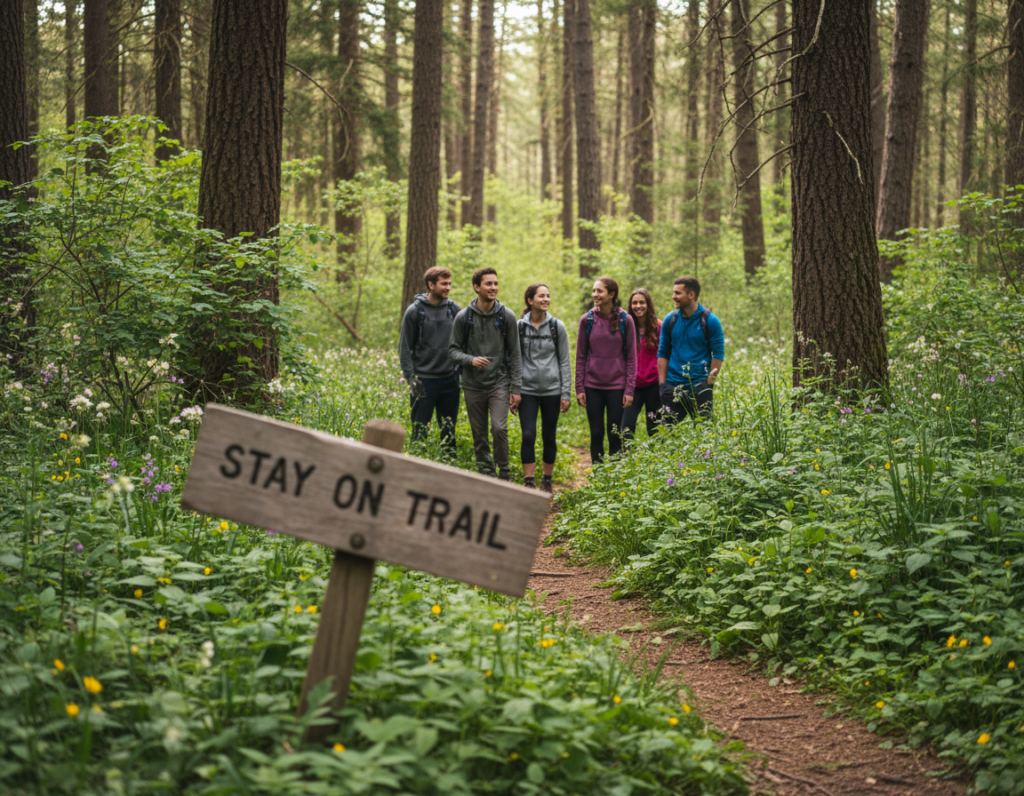
“Stay on trail” means keep your feet on the durable tread, even when the edge looks faster or drier. One person cuts a switchback; the next person follows those footprints. Before long the route splits and the soil weakens.
Water uses the disturbed line. It carves deeper ruts. The surface hardens, becomes slick, and the path gets unsafe for everyone.
Why off-route travel raises the chance of getting lost or stuck
Leaving the marked route hides landmarks and confuses phone maps. That can funnel you toward cliffs, loose scree, or dead ends. When you get stuck, rescuers must cover unstable ground to reach you.
- Self-check: if you can’t see where the official tread continues, stop and look for markers.
- Step back to the durable surface—rock, packed dirt, or the signed path.
- Pick legal alternates; they protect the landscape and prevent a needless rescue.
| What you do | Immediate effect | Long-term result |
|---|---|---|
| Cut a switchback | Shortens distance | Widened route and increased erosion |
| Follow a faint line | Lose repeatable markers | Higher navigation risk and rescues |
| Stay on durable tread | Protects soil crust and vegetation | Stable, safe route for all visitors |
Signs tied to sacred and culturally important areas
Many landscapes here carry stories written long before parks existed. In this region, people lived in, traveled through, and cared for these places for more than 10,000 years.
What visitors should know about long Indigenous presence
I’ve learned that Canyonlands and Arches sit on ancestral homelands of 30+ American Indian tribes. That history is visible in rock art, offerings, and old structures. These features are fragile and often sacred.
Why restricted access protects sites
Culturally restrictive messages usually mean: do not enter, do not touch, and do not share exact locations. Those rules stop vandalism and help keep ceremony spaces intact.
- Damage to markings or offerings is permanent.
- Human traffic can erase fragile pigments and small artifacts.
- Restricted areas keep the visit respectful and quiet for everyone.
| What you see | What the message asks | Why it matters |
|---|---|---|
| Roped boundary or posted notice | Do not enter the area | Protects fragile surfaces and ceremonial places |
| Labels: location withheld | Do not share exact coordinates | Reduces vandalism and looting risk |
| Interpretive viewpoint | Observe from designated spot | Learn respectfully without disturbing sites |
Simple habit: treat cultural boundaries like a home gate—no debate, no stepping over. Use official viewpoints and ask rangers for context. That small choice honors people past and present, and keeps these areas for future visitors.
Why “rules apply to everyone” matters in national parks
When a picture trend takes off, the pressure to reproduce that shot can drown out simple rules. I’ve seen whole groups move faster because a single clip made something look normal.
Social media changes risk tolerance. The “perfect shot” becomes the goal and posted instructions slip into the background. Tourists feel rushed, they copy the behavior, and choices that seem small multiply into real hazards.
How social media pressure leads to unsafe choices
Short clips create social proof: if many people do it, it must be safe. That logic is false. People mimic actions without reading what is posted. The result is crowding, damage, and more chance of an accident.
What park regulations aim to protect
- Visitor safety: rules keep you away from hazards that aren’t obvious.
- Undisturbed features: rules preserve views, wildlife, and fragile surfaces for everyone.
- Fair access: following rules keeps natural places available and intact for future visitors.
| Pressure source | Typical reaction | Negative outcome |
|---|---|---|
| Viral photos | Quick copying without reading | Crowds, unsafe moves, enforcement |
| Influencer buzz | Rushed approach for the shot | Damage to features and rescues |
| Peer pressure | Stepping past boundaries | Higher risk and closed access |
Mindset shift: you don’t need to be the exception to have a great day outside. The best photo is one you take from legal ground, leaving the place as you found it. Next, we’ll move from ethics into how policy and mission shape these rules.
What the National Park Service mandate means for trail signage
When you read a notice at the parking area, you are seeing park policy in action. The message traces back to a simple law: the Organic Act of 1916 directs parks to conserve resources “unimpaired” for future visitors.
The Organic Act in plain language
Put simply: parks must protect what exists today so people can enjoy it tomorrow. I think of it as stewardship written into law—keepers for the next generation.
How a post helps keep places open and safe
A single post guides behavior without fencing every acre. When people follow that guidance, damage drops. That means fewer full closures and less heavy rebuilding.
- Signage steers visitors away from fragile soil and cliff edges.
- Clear messages reduce preventable injuries and free rangers to handle true emergencies.
- Across the desert region, small choices protect big landscapes.
| Policy | On-the-ground tool | Outcome |
|---|---|---|
| Conserve unimpaired | Posted guidance | Longer public access |
| Visitor safety | Trailhead notices | Fewer rescues |
| Protect fragile features | Restricted area markers | Less erosion and damage |
Takeaway: when you follow the sign, you help keep the area available for the next season and the next generation.
How ignored warnings increase rescues and stretch ranger staffing
A single misstep in remote terrain can turn a quick outing into a multi-hour rescue operation. I’ve seen one call consume hours of planning, travel, and hands-on care.
What commenters mean by full rescue costs
When people debate “full rescue costs,” they mean recovering expenses for the operation: staff time, technical gear, medical care, and transport. The public argument asks whether someone who ignored posted guidance should shoulder those costs.
Why one incident ties up a whole shift
In remote rescues, a team travels slow and works methodically. That can remove one or more rangers from routine patrols for hours or a full shift.
- Typical rescue needs: multiple staff, rope or litter gear, medic support, and vehicle or helicopter time.
- Long evacuations block crews from other calls and slow response across the park.
- With fewer rangers covering more ground, visibility and patrol frequency drop.
| What it pulls in | Immediate effect | Why it matters |
|---|---|---|
| Search team and medics | Fewer staff on patrol | Longer response to other incidents |
| Technical gear and transport | High operational cost | Limits resources for concurrent events |
| Hours of staff time | Shift coverage gaps | Reduced visitor oversight |
Simple rule I use: if a choice could require a rescue if it fails, don’t take it. That small decision keeps you, a tourist, and others safer and helps rangers focus where they’re most needed.
Common sign designs hikers misread or dismiss
When the view steals your attention, short notices can vanish from sight and from mind. I’ve watched people frame a perfect shot and miss the posted warning right at their feet.
Why that happens: a warning describes what can go wrong, not what must be happening right now. Calm looks calm. That makes many visitors treat a notice as optional.
How crowds and camera angles hide guidance
At Canyonlands, the KEEP OFF ARCH post sits in the foreground while people pose on the span. The sign is visible, yet the photo moment erases it. Your phone frames the view; your eye skips the text.
Why closures break down when there are footprints
On Reddit, a STOP Trail Closed image showed fresh tracks past the barrier. Seeing others there sends a clear but false signal: someone already went, so it must be okay.
- Quick fix: when you reach a viewpoint, stop, scan for posted guidance, and read it before you move.
- Choose a different photo angle that includes the official marker so you don’t exclude safety from the frame.
- If many people ignore a rule, treat that as a sign enforcement is limited—not that the rule is optional.
| Common read | Why it fails | Easy habit |
|---|---|---|
| “It looks fine” | Risk is future-facing, quiet | Read the notice before stepping forward |
| “No one is stopping them” | Visible use normalizes behavior | Assume the rule still matters; pick a legal alternate |
| “I can’t see the post” | Crowd or camera angle hides text | Shift your position and scan the area |
Before you keep going, add one small rule: scan, read, then choose. That habit protects you and preserves the places we love. For more pre-hike checks, see this short guide on planning and safety: 10 essential hiking tips for beginners.
How to confirm rules at the trailhead before you start
I always pause at the trailhead board — it tells the day’s story faster than any app. Do this first and you cut the chance of walking into a same-day closure, a wildlife buffer, or freshly unstable ground.
Where to check current closures and restrictions for your park area
Look at the posted board at the trailhead first. Rangers update that board when conditions change quickly.
- Then check the park’s official closure or alerts page on the National Park Service site or the managing agency’s page for state and local parks.
- Call the ranger station if you need confirmation for that day.
- Do a right-before-you-go check online; many closures are issued the same morning for rockfall, fire response, or wildlife activity.
What to do when you see a sign that conflicts with a map or app
Follow the physical posting on site. If your map or app shows open but the posted notice says closed, the posted notice controls for safety and access that day.
- Refresh the park alert page and look for date stamps on the notice.
- If you’re unsure, ask a ranger on-site or call the field office before proceeding.
- Have a backup route planned so you can pivot without feeling pressured to bypass a closure.
| Check point | Why it matters | Quick action |
|---|---|---|
| Trailhead board | Fastest local update | Read before you step forward |
| Official park alerts page | Authoritative details and timestamps | Refresh and confirm |
| Ranger station | Clarifies conflicts and provides advice | Call or ask in person |
What to do when you see others breaking posted rules
Seeing a group push toward an unstable edge raises a simple question: what do you do next? Keep calm and put safety first. I’ve watched moments where a clear choice by one person pulled a crowd forward. You can act without escalating the scene.
How to report safety issues without escalating conflict
Don’t confront people near a cliff or loose rock. Instead, note simple facts and find a ranger or the nearest contact point. Use official phone numbers if posted and avoid sharing faces on social media.
- What to record: location name, nearest marker, what happened, and if anyone is hurt.
- Who to tell: on-site ranger, park phone line, or trailhead staff when you return.
- Keep your tone factual: describe risk, don’t accuse.
When to step back for your own safety
Step away when rocks are moving, ice hangs above a drop, or a crowded group pushes toward a fragile edge. If you feel nervous, leave the area and report from a safe spot. Modeling safe choices—turning back at a closure—often nudges others to follow.
| Situation | Safe action | Why it matters |
|---|---|---|
| People on an arch or ledge | Report location; do not approach | Prevents falls and preserves the feature |
| Loose rocks or visible falls | Move to stable ground; call for help | Reduces rescue need and risk to bystanders |
| Crowd ignoring a closure | Model safe behavior; inform a ranger | Discourages copycat moves and protects access |
Conclusion
Every posted instruction is a short, local lesson about immediate hazards and long-term loss. Read it as the park’s quick brief: what is unsafe now and what may never fully recover.
Across arches, closures, wildlife buffers, and fragile soil, the reasons are the same: protect your body, protect other hikers, and protect features that take years or centuries to heal.
High-impact habits: do not step onto arches, do not cross closures, stay on the trail, and give wildlife more space than feels necessary.
Before you go, check updates, read the board, pack a backup plan, and be ready to adjust. If you want tips on how to protect wildlife while hiking, see this guide: protect wildlife while hiking.
I promise: you don’t need risky photos to have an unforgettable day. Bring awareness, patience, and respect — and the places you love stay for the next person.
FAQ
What are the most commonly ignored signs in parks and why do they matter?
Why do overlooked signs keep appearing in recent park news?
What exactly does “KEEP OFF ARCH” prohibit at places like Canyonlands?
How can people on arches change the experience for other visitors?
Can vibrations and added weight really damage rock arches over time?
Do arches ever collapse suddenly?
How do rangers enforce violations like climbing on arches?
Why is “Trail Closed” a hard boundary rather than a suggestion?
What do rockfall warnings mean for liability and rescue efforts?
How do hikers typically bypass barriers and why does that escalate risk?
What can park staff do when people ignore closure signs?
Why do tourists dismiss rockfall and unstable terrain warnings?
How do loose rock, ice, and exposed edges create chain-reaction hazards?
What does a post-fire “area closed” sign signify on burned landscapes?
Why does ignoring post-fire closures slow recovery and strain local resources?
What is biological soil crust and why is it protected by signs?
How do footprints, bike tires, or vehicles damage the crust?
Where should I hike when trails aren’t established to avoid damaging crust?
How do wildlife distance and behavior warnings protect both people and animals?
What happens when visitors approach large animals too closely?
Why do “Stay on trail” signs help prevent injuries and resource damage?
How do shortcuts widen trails and increase erosion?
Why does off-trail travel raise the chance of getting lost or stuck?
What should visitors know about signs near sacred or culturally important sites?
How can visitors respect sites with cultural restrictions?
Why does “rules apply to everyone” matter in national parks?
How does social media pressure lead to unsafe choices around signs?
What role does the National Park Service mandate play in trail signage?
How does proper signage support future visitor access and safety?
How do ignored warnings increase rescues and stress ranger staffing?
What do people mean when they talk about full rescue costs?
Why do fewer rangers mean slower response times in emergencies?
Which sign designs do hikers commonly misread or dismiss?
Why do people treat a “warning” as optional when conditions look calm?
How can crowds and photo angles hide signs such as “KEEP OFF ARCH”?
Why do “closed” signs fail when there is still visible foot traffic?
How can I confirm current rules at the trailhead before I start?
What should I do when a sign conflicts with a map or app?
How can I report others breaking posted rules without creating conflict?
When should I step back for my own safety near cliffs or rockfall zones?
Related: What Causes Trail Erosion and How to Avoid It
