
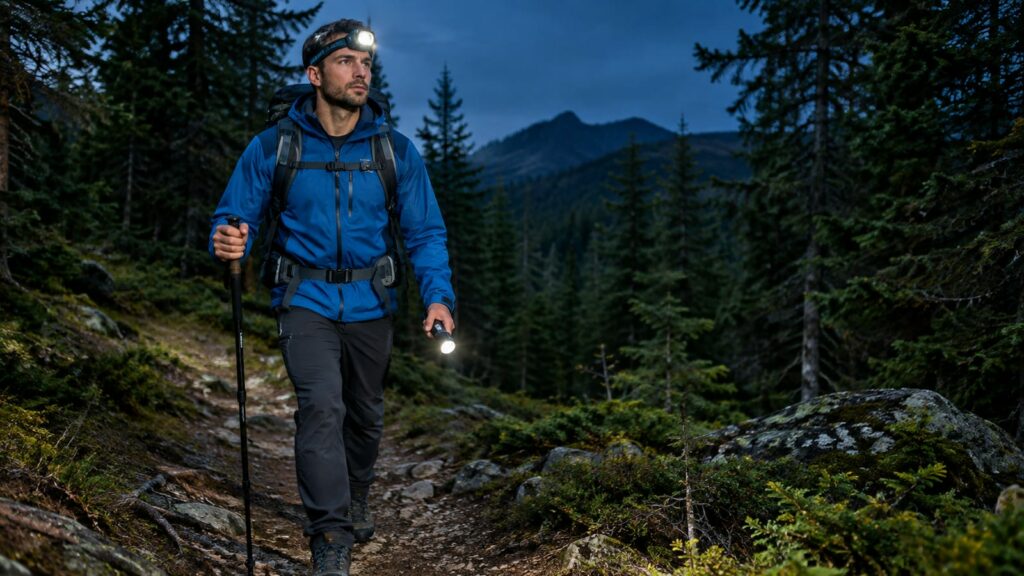
Start with a rechargeable headlamp, then add a compact handheld flashlight if your route is rough or remote. Among the top hiking flashlights and lanterns, the Black Diamond Spot 400-R is the best all-around hiking light because it balances comfort, beam control, charging, runtime, and weather resistance. The Fenix PD36R Pro earns the handheld slot for distance and emergencies, while a lantern belongs at camp unless you have a specific reason to carry one on the trail.
Last updated: 2026-09-23
A lantern spreads light around you. That helps with cooking, packing, and finding a dropped spoon. It does a poor job of showing the next rock, root, or switchback.
The right night hiking light source is a headlamp first
A headlamp keeps both hands free for balance, trekking poles, scrambling, and checking a map. That matters more after dark, when uneven ground and loose rock are harder to read.
A handheld flashlight still earns its place as a backup. It can point into a ravine, scan for trail markers, or give you a tighter beam when the headlamp’s flood light falls short. Keep it in an outer pocket where you can reach it without unpacking half your shelter.
A lantern is mainly a camp light. Its wide glow works around a cooking area or inside a shelter, but it wastes light when you need to see forward. Carrying one as your only night hiking light makes your hands busy and your trail view poor.
For most trips, use this order:
- Headlamp: Main trail light.
- Handheld flashlight: Distance, backup, and emergency signaling.
- Lantern: Camp chores and group use.
If you’re planning an overnight trip, pair your lighting plan with a sensible lightweight backpacking kit. A light that stays in your pack because it feels bulky has failed before sunset.
What are the top hiking flashlights and lanterns for night adventures?
The Black Diamond Spot 400-R is the best overall hiking light. The Nitecore NU25 UL is the better choice when every ounce matters. The Fenix PD36R Pro gives you the strongest handheld beam, while the Nitecore TINI 3 works as a small backup that you’ll actually carry.
For camp, the BioLite AlpenGlow 500 is the most useful area light in this group. The Goal Zero Lighthouse Micro Charge takes less room and makes more sense for a small shelter or trailhead stop.
| Light | Best use | Main strength | Main limit |
|---|---|---|---|
| Black Diamond Spot 400-R | Most night hikes | Comfortable rechargeable headlamp | More headlamp than you need for a short walk |
| Nitecore NU25 UL | Ultralight trips | Low weight and bulk | Less suited to people who want a large control layout |
| Fenix PD36R Pro | Handheld trail light | Long reach and rugged build | Too much light and weight for casual paths |
| Nitecore TINI 3 | Backup light | Pocket-sized and easy to carry | Not a main light for rough terrain |
| BioLite AlpenGlow 500 | Camp use | Bright, adjustable area light | Camp-focused rather than trail-focused |
| Goal Zero Lighthouse Micro Charge | Small shelter light | Compact warm area light | Limited role on moving trails |
Best flashlight for night hiking
The Black Diamond Spot 400-R is the best all-around hiking light because it covers the jobs most hikers actually face. You get a comfortable headlamp, a rechargeable battery, useful beam control, and enough runtime for a full outing.
That balance matters more than a dramatic maximum output number. A headlamp that stays steady on your forehead, switches modes without a fight, and does not bounce while you walk is safer than a brighter light that feels awkward after several miles.
Use it for:
- Evening walks that run past sunset.
- Solo day hikes with a late trailhead return.
- Backpacking trips where pack weight still matters.
- Reading a map or checking a shelter without unpacking.
- Moving through uneven trail, roots, and moderate rock.
The Spot 400-R is the sensible keep-it-simple pick. You don’t need a separate light for every small task.
Nitecore NU25 UL for ultralight trips
The Nitecore NU25 UL is the best ultralight option. It keeps weight and bulk low without turning safety into a gram-counting contest.
Choose it for fastpacking, short overnights, and day hikes where the headlamp may sit in your emergency kit until dusk. It makes less sense if you need a large, glove-friendly control layout or expect long hours on rough ground.
An ultralight light still needs to stay accessible. Store it near the top of your pack, not beneath your sleeping bag and the food bag. Saving a little weight does not help if you can’t reach the light when the trail takes longer than planned.
The best torch for hiking is the one you can control
The best torch for hiking is the one that stays accessible, survives drops and weather, and gives you useful runtime at a sensible brightness. Headline lumens help compare lights, but they don’t tell you how well the beam works on a rocky descent.
The Fenix PD36R Pro is the best handheld flashlight for hiking at night. Its maximum output is 2,800 lumens, and its beam reaches 380 meters. That reach is useful for route-finding, checking a distant trail feature, and signaling during an emergency.
It also carries an IP68 dustproof and waterproof rating. The light is rated waterproof to 6.5 feet for 30 minutes. That is reassuring in rain and wet conditions, although you should still keep charging ports closed and avoid treating any flashlight like a submarine.
The Fenix is worth carrying when:
- You hike alone after dark.
- The route has open terrain or long sightlines.
- You need to inspect a trail junction from a distance.
- You carry a pack where a backup light is reasonable.
- You want a handheld light for emergencies.
It is excessive for a smooth neighborhood path. A big beam does not make a flat walk more interesting.
Nitecore TINI 3 for backup duty
The Nitecore TINI 3 is the best compact backup flashlight. It fits in a pocket, hip belt, or small repair pouch and handles short walks, map checks, and equipment problems.
It won’t replace a headlamp on a rocky trail. Its value is that you’ll carry it every trip. A backup left at home has excellent specifications and no practical value.
Use the TINI 3 as a second light for:
- Checking a shoe or blister after dark.
- Finding a zipper pull inside a dark pack.
- Walking from a shelter to a nearby water source.
- Backing up a dead or misplaced headlamp.
- Signaling someone nearby.
The brightest light to carry at night is not always the best
A bright light can help on open ground, but maximum output drains batteries faster and can create glare. That glare bounces off pale rock, fog, dust, and nearby branches. You may see less after turning the light down than you expected.
Beam distance matters too. A narrow throw beam can show a trail marker far ahead, while a broad flood beam gives better awareness around your feet. Neither shape does every job well.
High output also affects other hikers. Blasting a group in the face ruins their night vision and makes it harder for them to see the trail. Use the lowest mode that gives you a clear view, then increase brightness for route-finding or hazards.
The Fenix PD36R Pro makes sense when you need its reach and ruggedness. For ordinary walking, the Black Diamond Spot 400-R or Nitecore NU25 UL is easier to live with.
A flashlight for walking at night needs control
A good flashlight for walking at night should have three useful levels:
- Low: Close work, maps, camp chores, and walking on smooth paths.
- Medium: Normal trail walking and most uneven ground.
- High: Route-finding, open terrain, distant markers, and emergencies.
You should be able to change modes with one hand. The grip should remain secure when your hands are wet or cold. Controls that require a long press, a confusing sequence, or bare fingers are a poor match for winter or stressful situations.
A red mode can help with map checks and camp tasks when you want to preserve dark adaptation. Keep it dim and pointed down. Red light is not a magic shield for night vision, especially when you turn it up until the whole campsite glows.
For emergency signaling, a handheld light gives you better aim and reach. A headlamp can work, but waving your head around is a poor substitute for pointing a beam where another person can see it.
Best lanterns for night hiking and camp
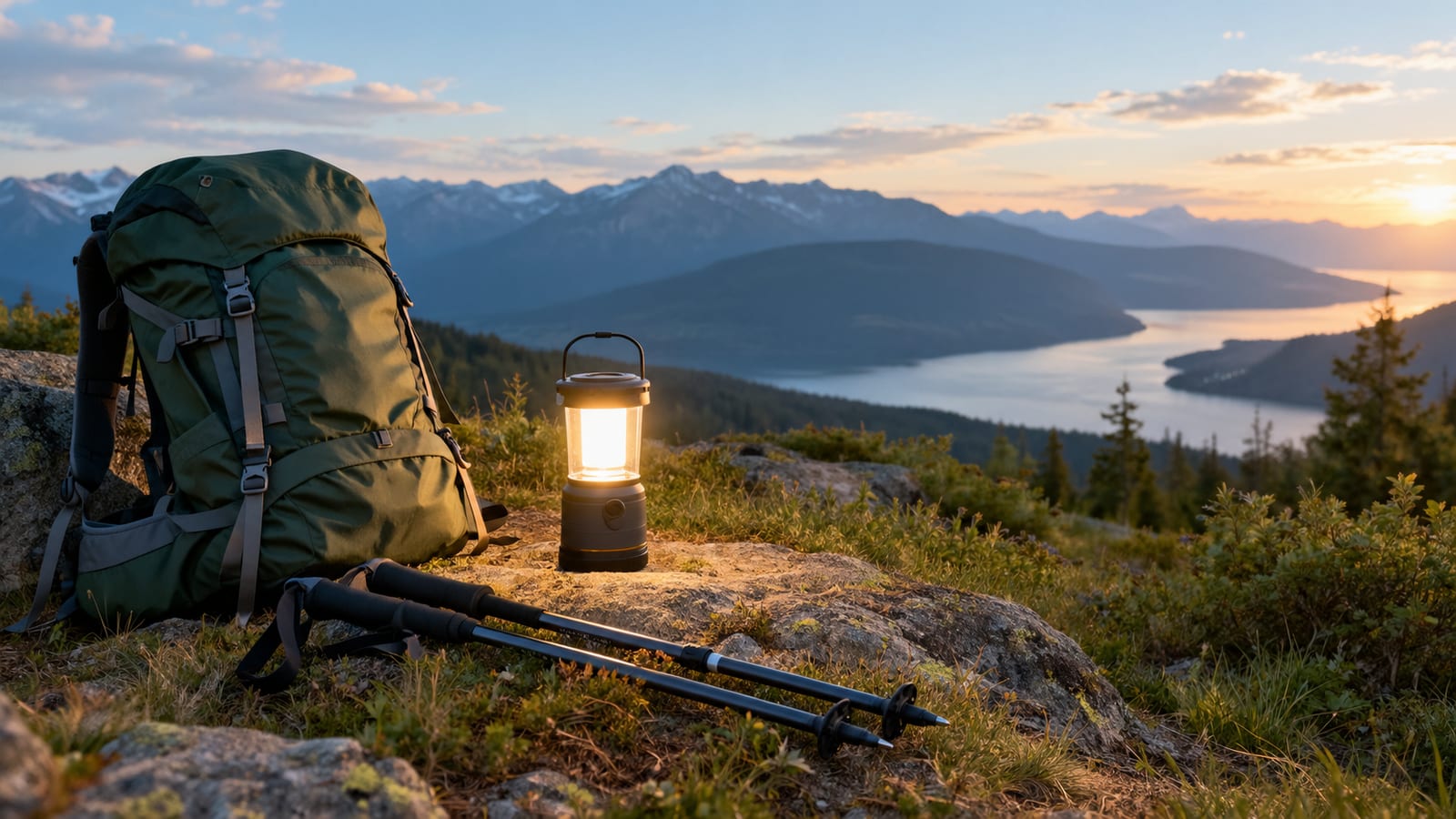
Lanterns earn their weight at camp. They light a cooking area, help you sort gear, and make a shelter easier to use when your hands are full.
The BioLite AlpenGlow 500 is the best lantern for camp. Its adjustable area light suits cooking, packing, and group use better than a narrow flashlight beam. Use it when several people need light at once or when a shelter has too many dark corners.
The Goal Zero Lighthouse Micro Charge is the better small lantern for trailhead and shelter use. It adds warm area light without taking much room in a pack. It suits a solo overnight, a car-camping setup, or a small shelter where you only need light for basic tasks.
The Goal Zero Lighthouse 600 is a larger camp option. It produces up to 600 lumens, weighs 1.1 pounds, and runs for 320 hours on low with one side illuminated. With both sides illuminated, its listed low runtime is 180 hours.
That light is useful at a base camp or vehicle. It is a poor backpacking choice if you already carry a headlamp and handheld flashlight. The extra weight earns its place only when the broader light and USB power function solve a real camp problem.
Choosing a lantern for trail walking at night
A lantern is usually secondary on a moving trail because its diffuse light spreads in every direction. That makes it good for area lighting and weak for seeing a narrow path ahead.
Carry one while walking only in specific cases:
- You need low area light around a group.
- You’re moving slowly around a shelter or campsite.
- Your route is short, smooth, and familiar.
- You want a light that can sit on the ground while your hands work.
- You’re managing a group where visibility matters more than pace.
For most trail miles, use a headlamp. A lantern for trail walking at night is a specialist tool, not the default.
Hiking lights for nights: headlamp, flashlight, or lantern
Use this simple decision chart before packing:
| Your situation | Main light | Add this |
|---|---|---|
| Solo hike after work | Rechargeable headlamp | Compact backup flashlight |
| Rough trail or loose rock | Headlamp with flood control | Handheld flashlight with a focused beam |
| Group outing | Headlamp | Camp lantern for stops |
| Long sightlines or route-finding | Headlamp | Fenix PD36R Pro |
| Short trailhead walk | Compact headlamp | Pocket backup if the area is unfamiliar |
| Overnight shelter setup | Headlamp | Small lantern |
| Car camping | Headlamp | Larger camp lantern |
| Emergency backup | Headlamp | Pocket flashlight and spare power |
The rule is simple. Your main light should help you walk. Your second light should help you recover when the first one fails. Your lantern should make camp easier.
Battery, charging, and runtime matter after several miles
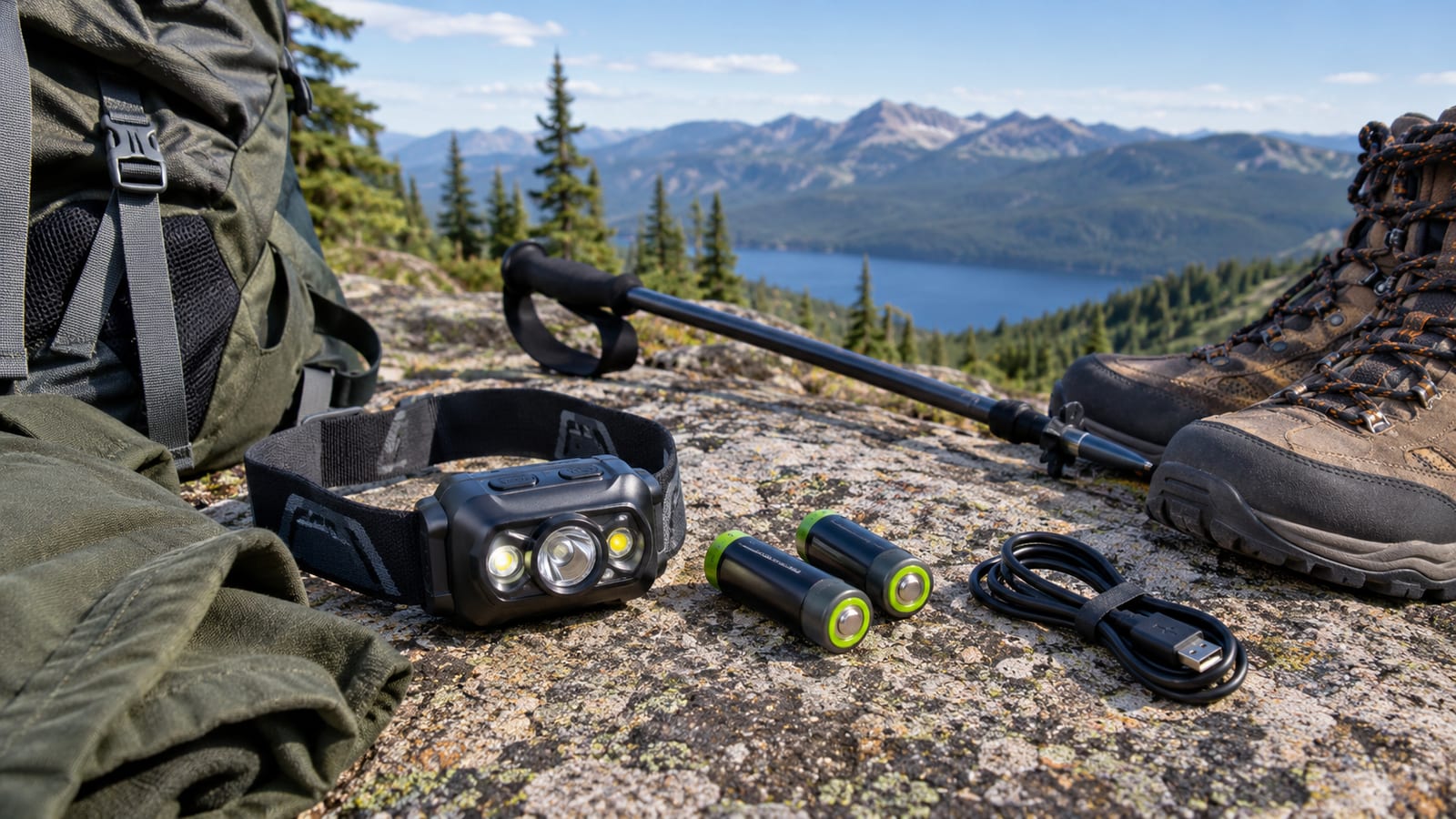
Rechargeable lights are convenient and reduce the need to carry loose batteries. They work well when you can charge before a trip and have a power bank for longer outings. However, a dead rechargeable light is still dead, even if the battery indicator looked cheerful at home.
Replaceable batteries make more sense on long trips, cold-weather routes, or trips without reliable charging access. Cold reduces battery performance, so keep spare power close to your body rather than buried in an outside pack pocket.
Check these points before leaving:
- Does the light show remaining battery power clearly?
- Can you charge it with the cable you already carry?
- Will the port stay closed in rain?
- Can you pack a spare battery or power bank?
- Does the useful medium mode last long enough for your route?
- Will you still have light if the hike runs late?
Do not plan around the highest setting. Use the runtime at a practical brightness instead. A light that lasts longer on a lower mode gives you more options after mile 10.
If charging is the weak point in your setup, compare solar chargers for hikers with a small power bank. Solar panels are useful on long trips, but they need sun, exposed space, and patience. A power bank is less exciting and usually easier.
Beam shape, comfort, and weather protection
A flood beam helps you see roots, nearby rocks, and trail edges. A throw beam reaches farther and works well for open terrain or distant markers. The Black Diamond Spot 400-R is the better general trail shape, while the Fenix PD36R Pro earns its place when distance matters.
Comfort is part of safety. A loose strap makes the beam bounce. A heavy headlamp can create forehead pressure and neck fatigue. Adjust the strap before leaving the trailhead, then test it while looking down at your feet.
Weather protection matters in wet forests, shoulder-season rain, and river crossings. An IP rating describes dust and water protection, but it doesn’t excuse poor care. The IEC IP rating system explains what those ratings mean. Keep seals clean, close charging covers, and dry the light before storage.
Packability also affects use. The Nitecore NU25 UL fits trips where space and weight are tight. The Nitecore TINI 3 fills a smaller backup role. The Goal Zero Lighthouse 600 belongs in a vehicle or base camp unless your group has a clear reason to carry it.
A practical night-light kit for hikers
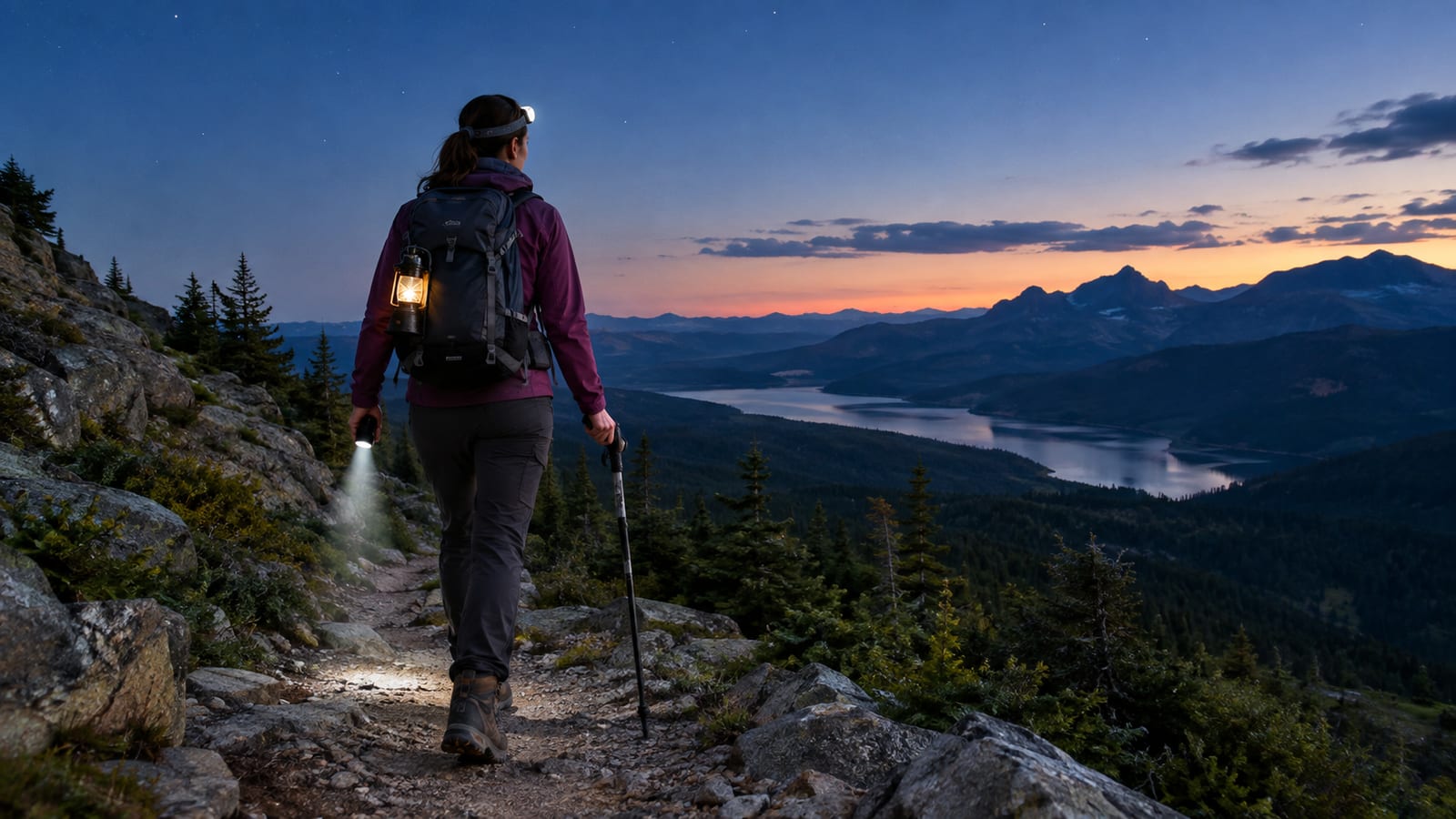
A wallet-conscious night hiking kit needs four things:
- One dependable headlamp: The Black Diamond Spot 400-R is the best general choice.
- One compact backup: The Nitecore TINI 3 covers short tasks and light failures.
- Spare power: Carry the right cable, a charged power bank, or replacement batteries.
- One lantern when camp tasks justify it: Choose the BioLite AlpenGlow 500 for group use or the Goal Zero Lighthouse Micro Charge for smaller setups.
Add the Fenix PD36R Pro when you need a long-reaching handheld beam, rough-weather confidence, or a stronger emergency signal. Skip the large lantern on a backpacking trip unless it solves a real cooking, shelter, or group-lighting problem.
The safest setup is the one you can reach, operate, and trust when the trail runs longer than planned. Keep it simple, charge it before leaving, and test every light in the dark before the trailhead parking lot empties.
FAQ
Is a headlamp safer than a flashlight for night hiking?
Usually, yes. A headlamp leaves both hands free for balance, trekking poles, and scrambling. A handheld flashlight still makes sense as a backup or for checking distant trail features.
How many lights should you bring on a night hike?
Bring one main headlamp and one backup light. Add a lantern only when you’ll cook, sort gear, or manage a group at camp.
Should you use red light while hiking at night?
Use red light for close tasks and brief map checks. For uneven trail, white light usually gives you a clearer view of roots, rock, and trail edges.
Is a high-lumen flashlight necessary for a normal hiking trail?
No. High output helps with distance and emergencies, but it also creates glare and drains the battery faster. Most hikers need reliable control and useful medium output more than maximum brightness.
Where should you store your backup flashlight?
Keep it in an outer pack pocket, hip belt, or jacket pocket. If you need to empty your pack to reach it, it isn’t a backup.
