

Have you ever felt sure you knew a trail, only to find yourself turned around when the fog closed in?
I have seen that shift: a hiker on a familiar route ignored maps as mist rolled onto a plateau and walked a large circle. They thought they faced east but were actually facing west.
Another seasoned person on the John Muir Trail took the wrong branch after following the crowd and asking others for confirmation. Those real examples show how simple choices can become serious risks when conditions change.
Put plainly, overconfidence means you skip checks that keep you safe. Confidence and experience help—but they must link to facts you can verify: maps, bearings, and clear plans.
In this article you will learn common bias patterns, the conditions that punish mistakes, basic navigation habits, and group decision tactics. You can stay adventurous and still make the careful calls that keep trips safe.
Key Takeaways
- Feeling sure? Always confirm with a map or compass before you move on.
- Visibility and fatigue turn small route errors into real emergencies.
- Real examples (mist on a plateau, a wrong turn on the JMT) teach practical lessons.
- Link confidence to verifiable facts: check bearings, junctions, and plans.
- Learn the bias patterns that lead to wrong turns and late-day problems.
Why confidence on the trail can turn into a safety problem
Confidence speeds decisions on the trail, and that can be helpful—until conditions shift.
Confidence helps decision-making until conditions change
When the path matches your map and the weather stays calm, you move faster. You pick lines, skip repeated checks, and trust memory. That makes trips efficient and enjoyable.
Small errors compound fast in backcountry situations
One missed junction adds miles. Extra miles cost time and daylight. Then people rush choices and mistakes grow.
- Why delays matter: poor cell service, fewer bailout options, and slower travel off-route.
- Common starters: skipping a map check, ignoring a sign, or trusting memory over the map.
- Concrete decision point: “At this point, I should stop and confirm location, not keep walking to see if it fixes itself.”
| Quick decision | Simple check | Benefit |
|---|---|---|
| Keep moving | Stop and read map | Prevents extra miles |
| Follow the crowd | Confirm junction | Avoid wrong trail |
| Assume direction | Take bearing | Save daylight |
Practical mindset: verify early. The cost of turning around grows with time. You can move with confidence while still checking facts—start with small checks and set clear decision points. For pacing and time buffers, see tips to pace yourself on long trails.
How overconfidence hiking shows up on real hikes
Sometimes the place you think you know best is where you get it wrong fast. I’ve seen mist erase familiar landmarks and a clear route turn into a guessing game.
Skipping maps on “familiar” routes
You tell yourself the map isn’t needed. That’s the first pattern to watch for. Mental maps break when visibility drops or you approach a trail from a new direction.
Assuming a short hike does not need a plan
Short trips lure late starts and light packs. Then a delay or wet ground eats time, and the situation becomes harder to fix.
Ignoring doubts at a junction and committing to the wrong trail
Pressure to pick fast breeds mistakes. On the John Muir Trail a leader followed a busier fork and dismissed a partner’s question—later they confirmed they were off route.
- Three patterns to spot in yourself: skipping the map, skipping the plan, dismissing doubt.
Ask at forks: “What feature should I see in the next 10 minutes if I’m right?” Treat doubt as useful data. The moment you feel rushed is the moment you stop and verify.
Getting lost on a familiar trail when visibility drops
A clear morning can flip to whiteout in minutes. I watched mist thicken until hikers could see only a few meters.
How mist and low visibility break your sense of direction
The trail still feels mostly right at first. Distant landmarks vanish. Your internal compass drifts without you noticing.
On a small plateau the group walked a large circle. One hiker believed they faced east. They were facing west.
Why stopping early matters when the ground stops matching memory
Stop the moment the terrain does not match memory. Moving costs time and widens the search area. Fatigue grows and options shrink.
- Stand still and breathe.
- Check map, compass, or GPS now.
- Confirm a bearing and pick a nearby handrail (ridge, creek, trail).
| Action | Why it helps | When to do it |
|---|---|---|
| Stop and locate | Prevents extra miles | As soon as things feel wrong |
| Confirm bearing | Orients the group | Before you move |
| Pick handrail | Keeps you on a known feature | After location is set |
Should you keep going to see if it clears? The short answer: only after you confirm your location.
Wrong turns on well-marked routes can still happen
Crowds and clear bootprints can mask multiple destinations at the same junction. I saw this on the John Muir Trail when a busier fork felt “right” and led a party away from their planned route.
How a busy trail creates false confidence at junctions
Foot traffic often follows more than one objective. A packed tread looks safe, so people pick it without checking the map.
At a fork the main line feels like the point to follow. That instant judgment can cost time and water later.
How confirmation from other people can mislead you
On the JMT someone asked where others had come from. They heard “Sunrise” and assumed Sunrise Camp. Later they found they were heading toward Sunrise Lakes and Clouds Rest instead.
- Why busy trails fail: bootprints and signs can serve different destinations.
- Junction trap: the main path feels safer than a steeper, less-used line.
- Social proof: seeing people move a way does not confirm your route.
Safer script: ask, “What destination are you heading to?” and “What junction did you last pass?”
| Risk | Cause | Quick fix |
|---|---|---|
| Extra miles | Choosing busy line | Stop and read map |
| Lost time | Vague confirmation | Ask specific question |
| Reduced daylight | Late correction | Verify bearing before ascent |
Always confirm with your own map before you commit. A wrong turn on a popular trail still carries real risks: wasted time, lost water, and a harder return. Ask clear questions and verify your position first.
The Dunning-Kruger effect and hiking skills you think you have
Early wins can make you feel more capable than you are. In plain terms: Dunning-Kruger is when weak knowledge produces high confidence, and on the trail that mismatch shows up fast.
What “you don’t know what you don’t know” looks like on the trail
You might follow a faint path because it feels right, misread a junction sign, or trust memory instead of checking the map. Those are concrete examples of unseen gaps in judgment.
Early skill gains can inflate confidence faster than judgment improves
Basics come quickly: you learn to read a map, use a compass, and feel clever. But making sound choices under stress and changing conditions takes practice.
Even if you have hiked for years, a new route or season can expose blind spots.
Red flags and corrective habits
Watch for these warning signs: you resist new learning, you dismiss a partner’s feedback, or you “power through” to avoid admitting doubt.
- Invite a single check-in question before big moves: “What would prove us wrong?”
- Mix leaders: pair less experienced members with those who have broader experience and an open mindset.
- Use Socratic prompts—play devil’s advocate to test assumptions and correct false information early.
Experience matters most when it stays curious. Treat every trip as a chance to update what you know and protect the confidence you rely on.
Confirmation bias: how hikers explain away warning signs
Small signals—darkening clouds, a missing cairn—are easy to explain away when you really want to reach the goal. I’ve seen parties twist facts to fit their map and their timeline.
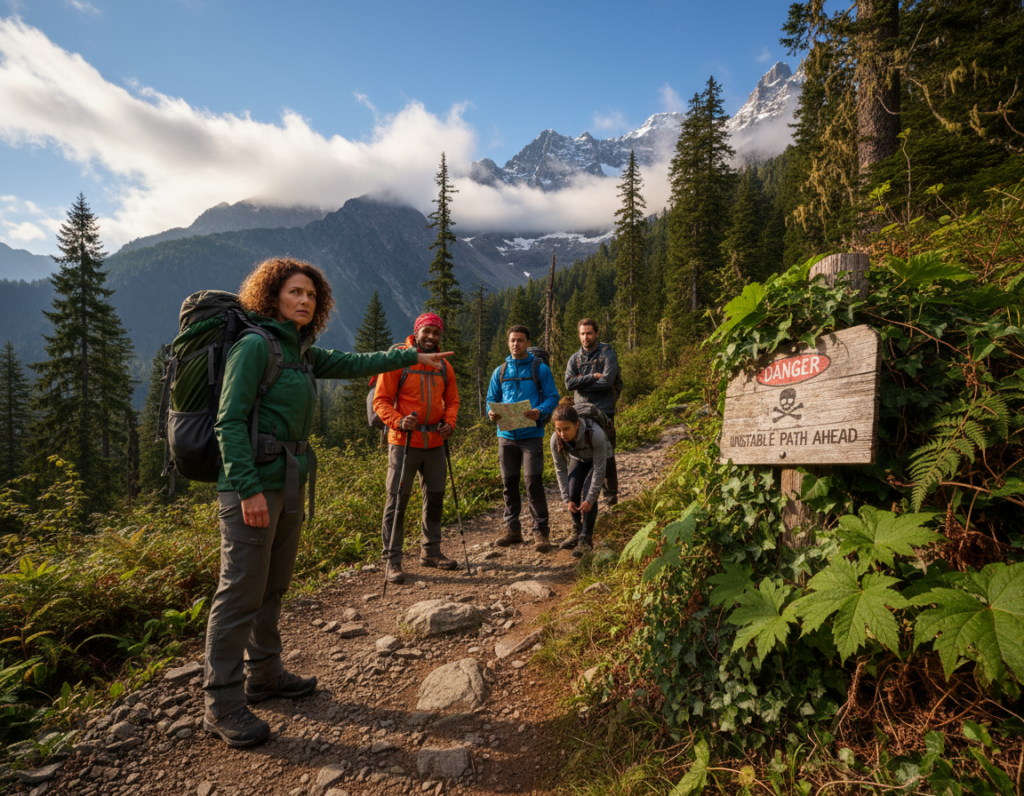
How people discredit new information that challenges their plan
Confirmation bias means we notice facts that support our plan and ignore facts that do not. On the trail it sounds like: “The clouds will pass,” or “This always goes this way.”
Common examples you can spot now
- Fast weather shift: sudden wind or cloud cover that you call temporary instead of reassessing.
- Navigation uncertainty: a junction looks familiar, so you dismiss a bad feeling.
- Avalanche concerns: weak snowpack is minimized because the summit is close.
Bias rises near the goal because people feel invested and explain away signals. That raises risk in changing conditions and in any tight situation.
Use a short devil’s-advocate script: “What changed?” “What’s the safest alternative?” “What’s our exit?” Asking that single question can break the pattern.
Changing the plan is a skill. Treat it as smart practice, not failure. You can keep ambitious goals and still pivot when the facts demand it.
Weather and trail conditions that punish overconfidence
A sunny start can lull you into choices that the afternoon will punish. I’ve learned to respect that swing: what looks fine at dawn can change fast by midday.
When a clear morning turns into a risky afternoon
Blue skies often lead to a light pack and a quick pace. Then storms, wind, or fog can arrive and slow you down. Slower pace eats daylight and raises the chance of a wrong turn late in the day.
Cold, heat, and wet ground change pace and injury risk
- Slick rock, mud, or snow patches force cautious moves and more breaks.
- Wet clothing plus wind drops body temperature and slows fingers that hold a map or phone.
- High heat drains water and focus, making junction errors more likely.
- Slips on wet ground can cause sprains that turn a routine day into a rescue.
Practical habit: check the forecast, then reassess as you gain ridge or valley time. Even skilled hikers must slow down when the trail surface changes.
| Situation | Risk | Quick fix |
|---|---|---|
| Afternoon storm | Reduced visibility | Stop, confirm location |
| Wet ground | Slips/injury | Pick secure handrail |
| High heat | Dehydration | Increase breaks & water |
Navigation basics to use every time, even on short hikes
A five-minute plan before departure stops many small errors from growing into big problems.
Plan the route in four quick steps: pick your start point, pick your end point, mark key junctions, and set a turnaround time you will honor.
Set clear decision points before you go
Name three deliberate points on the map where you will stop and confirm location: junctions, ridge tops, and creek crossings are good ones.
Use the maps during the hike, not just as a backup
Check your position every 30–60 minutes or after any major change in terrain. Matching ridge lines, creek direction, and elevation gain to the map catches errors early.
Stop, locate, and reorient when the trail stops making sense
If the trail feels wrong, stop immediately. Locate yourself with map, compass, or GPS. Reorient the group and pick a safe handrail before you move.
- Plan your route and set a firm turnaround time before you leave.
- Mark decision points on the map and pause at each to confirm direction.
- Use maps actively: check position often so small errors stay small.
- When unsure: stop, locate, reorient—then move only after you confirm the next point.
- Adjust the plan when conditions change: fog, ice, or poor light means shorten the route early.
- Practice these skills on short ones so they become second nature on longer days.
| Step | What to do | Why it helps |
|---|---|---|
| Pre-trip plan | Set start/end, key junctions, and turnaround time | Limits late decisions and keeps expectations realistic |
| Decision points | Stop and confirm at marked locations | Catches errors before they add miles |
| Active map use | Match terrain features to maps every hour | Detects drift or misread bearings early |
| Stop-locate-reorient | Halt, find position, pick handrail, then move | Prevents wandering and reduces rescue risk |
Navigation tools that reduce risk when people get turned around
Gear can save you when the map in your head and the ground disagree. Use a mix of electronics and no-battery backups so you can confirm your position in many situations.
Smartphone or GPS with offline maps
I download offline maps before each trip and keep my phone in airplane mode to save battery. GAIA GPS is my go-to for offline layers; Garmin Explore is a useful second app for redundancy.
Preload the route files on gpx.studio, then compare your live track to the planned route to spot drift early.
Physical map and compass as a no-battery option
A laminated map and a compass work in every area and never die. Learn basic bearings and map-reading so you can orient quickly when electronics fail.
Personal locator beacon or satellite messenger
For remote routes, carry a device that can summon help. The Garmin inReach Mini 2 sends emergency alerts, allows two-way text, and provides tracking so rescuers know your last known location.
Practice with your tools before you need them
Spend time using apps, following a printed route, and taking bearings on easy ones. The tools that matter most are the ones you can deploy fast under stress.
| Tool | What it does | When to use |
|---|---|---|
| GAIA GPS (offline) | Detailed maps and route tracking | Every trip; preload maps before departure |
| Laminated map & compass | No-battery navigation and bearings | Always; backup for electronics |
| Garmin inReach Mini 2 | Emergency messaging and tracking | Remote area or long time from help |
Planning habits that keep confidence aligned with reality
Good planning keeps a confident step from turning into a late-night scramble. I set a clear frame before every trip so choices stay calm when things shift.
Match the day’s goal to your current fitness and skills
I pick a goal based on recent walks, not wishful thinking. If my longest recent day was 6 miles and steep, I won’t assume an 18-mile route will feel the same.
Build buffer time for slow terrain and wrong turns
I add margin for breaks, tricky sections, navigation checks, and possible wrong turns. If a route “should” take 4 hours, I plan for 6 and set a firm turnaround time.
Carry enough food, water, and layers for a longer day
Bring an extra layer, rain shell, headlamp, and 500–800 extra calories per person. Carry at least one liter more water than the estimate. Those small things buy options when weather or conditions slow you down.
| What to carry | Why it helps | When to use |
|---|---|---|
| Extra layer & rain shell | Keeps core warm and dry | Cold, wind, or rain |
| Headlamp | Safe travel after sunset | Late return or emergency |
| Extra food & water | Maintains energy and judgement | Long day or unexpected delay |
Group dynamics that increase or reduce risk
A strong voice at the front may speed choices—but it can also drown out useful questions.
How a strong leader can miss input from others
I’ve watched a leader dismiss a partner’s doubt at a junction, then follow the crowd and discover they were off route. A single confident person can mask small warnings from quieter members.
When someone raises a concern, stop. Check the map together. Make the check public so everyone updates their mental plan.
Use “devil’s advocate” questions to test assumptions
Adopt short scripts to probe choices. Try: “What would make this the wrong trail?” or “What should we see in the next ten minutes?”
These questions force verification and turn doubt into data, not drama.
Pair less experienced hikers with more experienced partners
Match people so skills and judgment grow on real routes. Agree on decision points and a turnaround time before you step off.
- Leader names changing conditions out loud so the group updates plans.
- Encourage every person to speak up early; questions are safety tools.
| Practice | Why it helps | When to use |
|---|---|---|
| Stop-and-check at junctions | Prevents wrong turns | Any fork or doubt |
| Devil’s-advocate question | Tests assumptions | Before committing to a line |
| Pairing partners | Builds real experience | On unfamiliar or hard routes |
Simple rules for safer decisions at the moment of doubt
The moment you question the route is the best time to act, not hesitate.
Use a turn-around time and follow it
Set a firm turnaround time before you leave. Write it down or tell the group.
If the time arrives, turn back even if the goal is close. Daylight and energy fall faster than you expect.
Backtrack early when landmarks and maps do not match
Backtrack to known ground. The way behind you is easier to confirm than guesses ahead.
Stop as soon as map and landmarks mismatch. Reorient, then choose a safe route or return.
Change the plan when conditions shift, even near the goal
When weather or conditions change, shorten the plan. Pick a lower option or head the way you came.
If one person voices doubt, treat it as real data. Pause, ask the single question: “What is the safest next 10 minutes?”
- Pause immediately on doubt.
- Confirm position within five minutes.
- Backtrack if confirmation fails.
- Adjust the plan early—don’t chase the original goal at the cost of safety.
| Rule | Why it works | Quick action |
|---|---|---|
| Turnaround time | Protects daylight and energy | Honor the set time |
| Backtrack early | Uses known terrain to reorient | Return to last confirmed point |
| Change the plan | Keeps people safe when conditions worsen | Shorten route or choose lower option |
Conclusion
Simple verification wins: stop, confirm, and move with purpose.
Confidence helps you move fast, but it must tie to facts. The biggest risks I described were getting lost in low visibility, wrong turns at junctions, and pushing past warning signs that should stop you.
Always check maps during the hike. Use clear decision points. Stop early when the ground or conditions stop matching your plan.
Weather and time matter: a small delay can become a late-day problem. Group habits matter too—invite questions, listen, and use a short devil’s-advocate check.
Quick checklist: plan the route, carry the right gear and food, practice your tools, and set a firm turnaround time. Learn from mistakes; your skills grow with years and experience.
The answer is simple: safer hiking starts with steady verification, not wishful thinking—start today.
