
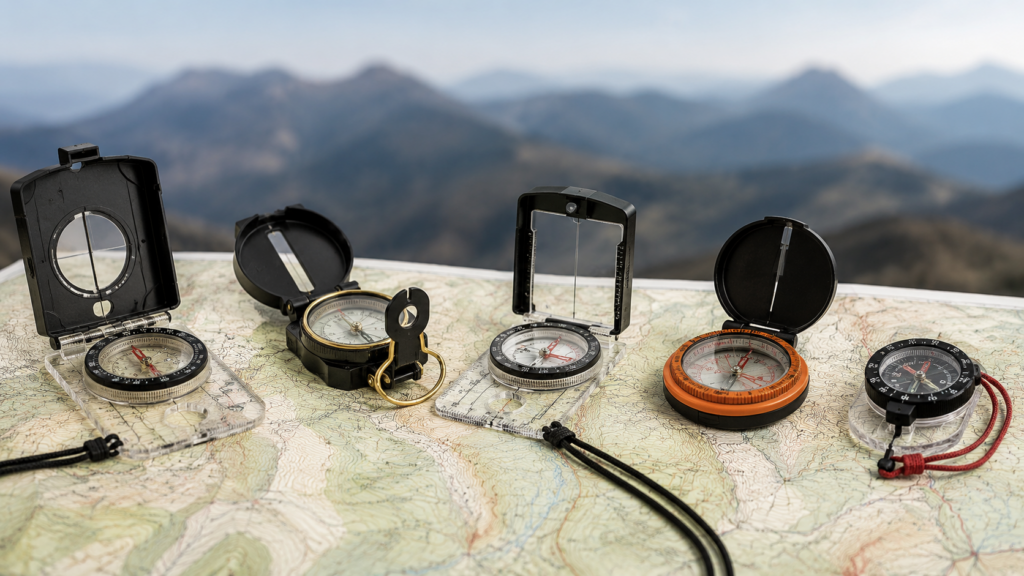
The best backpacking compass for most people is the Suunto MC-2, a mirror-sighting model with adjustable declination that weighs about 1.6 ounces. If you want to spend less, the Suunto A-10 baseplate covers real trail navigation for a fraction of the cost. Serious sighting work or rough handling points you toward a lensatic model. Everything after that is matching the compass to your terrain, your budget, and how much you actually navigate off-trail.
Last updated: 2026-07-01
Here is the honest part most roundups skip: for a well-marked trail, almost any decent baseplate compass will do. You buy up when you leave the marked route, travel off-trail, or need to plot bearings on a map in bad light. Weight barely matters here. Even the heaviest option on this list is lighter than a full water bottle, so pick for features and durability, not grams.
Which backpacking compass should you buy?
Here are the picks, judged for backpacking use, not orienteering races or military field exercises.
| Compass | Type | Declination adjustment | Best for | Verdict |
|---|---|---|---|---|
| Suunto MC-2 | Mirror sighting | Yes, tool-free | Off-trail navigation, map work | Best overall |
| Suunto A-10 | Baseplate | No (fixed) | Marked trails, first compass | Best budget |
| Silva Ranger 2.0 | Mirror sighting | Yes | Map-heavy trips | Solid MC-2 alternative |
| Cammenga lensatic | Lensatic | No | Rough handling, night sighting | Overbuilt for most hikers |
| Eyeskey sighting | Lensatic-style | No | Cheap sighting backup | Good enough as a spare |
Suunto MC-2 (best overall). This is the one I point most backpackers toward. It has a mirror for sighting distant landmarks, a clinometer for reading slope angle, and declination you can set once and forget. At around 1.6 ounces it earns its spot in the pack. The mirror also doubles as a signal mirror and a way to check your own eye for a stray bug. It costs more than a plain baseplate, and if you never leave marked trails you will not use half of what it offers. But for anyone plotting bearings on a topo map, the declination adjustment alone is worth the money.
Suunto A-10 (best budget). A stripped-down baseplate that does the core job: take a bearing, follow it, read a map. No mirror, no clinometer, and declination is fixed, which means you do the true-north math in your head or on the map. For day hikers and new backpackers sticking to trails, that is fine. This is where cheaper is not a false economy. Buy it, learn on it, and upgrade only when you know you need the extra features.
Silva Ranger 2.0. A close competitor to the MC-2 with adjustable declination, a magnifying lens, and Romer scales for reading map coordinates. If you find it cheaper than the Suunto or prefer how it sits in the hand, you lose nothing. Silva and Suunto have traded the "serious navigator's compass" title for years, and the marketing on both sounds better on a hang tag than it feels different on the trail. Pick on price and feel.
Cammenga lensatic. Built like it expects to be run over, with a tritium-lit dial that glows for years without charging and a sighting system for precise bearings. The catch: lensatic compasses are harder to learn, most models do not adjust for declination, and they work better with military grid maps than with the topo maps most backpackers carry. The "military-grade" label is real toughness, not a reason every hiker needs one. Skip it unless you already know you want a lensatic.
Eyeskey sighting compass. A cheap aluminum sighting compass that gets recommended constantly because it costs little and feels solid. It sights well enough and survives a drop. It has no declination adjustment and the fit-and-finish reminds you what you paid. As a backup tucked in a lid pocket, it is good enough. As your only compass for off-trail work, you will wish you spent more.
What actually matters in a backpacking compass
Marketing lists a dozen features. Four of them decide whether the compass helps you after mile 10.
- Adjustable declination. The gap between true north and magnetic north shifts depending on where you stand, and it can throw you off by miles over a long bearing. A compass you can set once beats doing arithmetic every time you check the map, especially when you are cold and tired.
- A baseplate that works with your map. Straight edges, a ruler, and clear index lines let you lay the compass on a topo map and plot a bearing. This is the whole point of a baseplate compass, and a wrist or clip-on model cannot do it.
- Readable in bad light. Luminescent markings or a tritium dial matter for dawn starts and dusk finishes. A phone flashlight held in your teeth is not a navigation plan.
- A liquid-filled capsule that settles fast. A needle that wobbles for ten seconds every reading wears on you. Better capsules dampen quickly and keep working in the cold.
Notice what is not on that list: weight. A quality baseplate or mirror compass runs a couple of ounces at most. Chasing the lightest option here is solving a problem you do not have.
Where these compasses fall short
Every compass on this list shares the same weaknesses, because they are physics, not defects.
Metal throws them off. Hold a compass near your trekking poles, phone, belt buckle, or a car and the needle lies to you. Step away from metal before you trust a bearing.
Mirror hinges are the part that breaks. The MC-2 and Ranger both fold, and a cracked hinge is the most common failure on this style. Do not sit on your pack lid.
Bubbles happen. Liquid-filled capsules can develop an air bubble in cold or at altitude. A small one is cosmetic. A large one that covers the needle means the seal failed, and that compass is done.
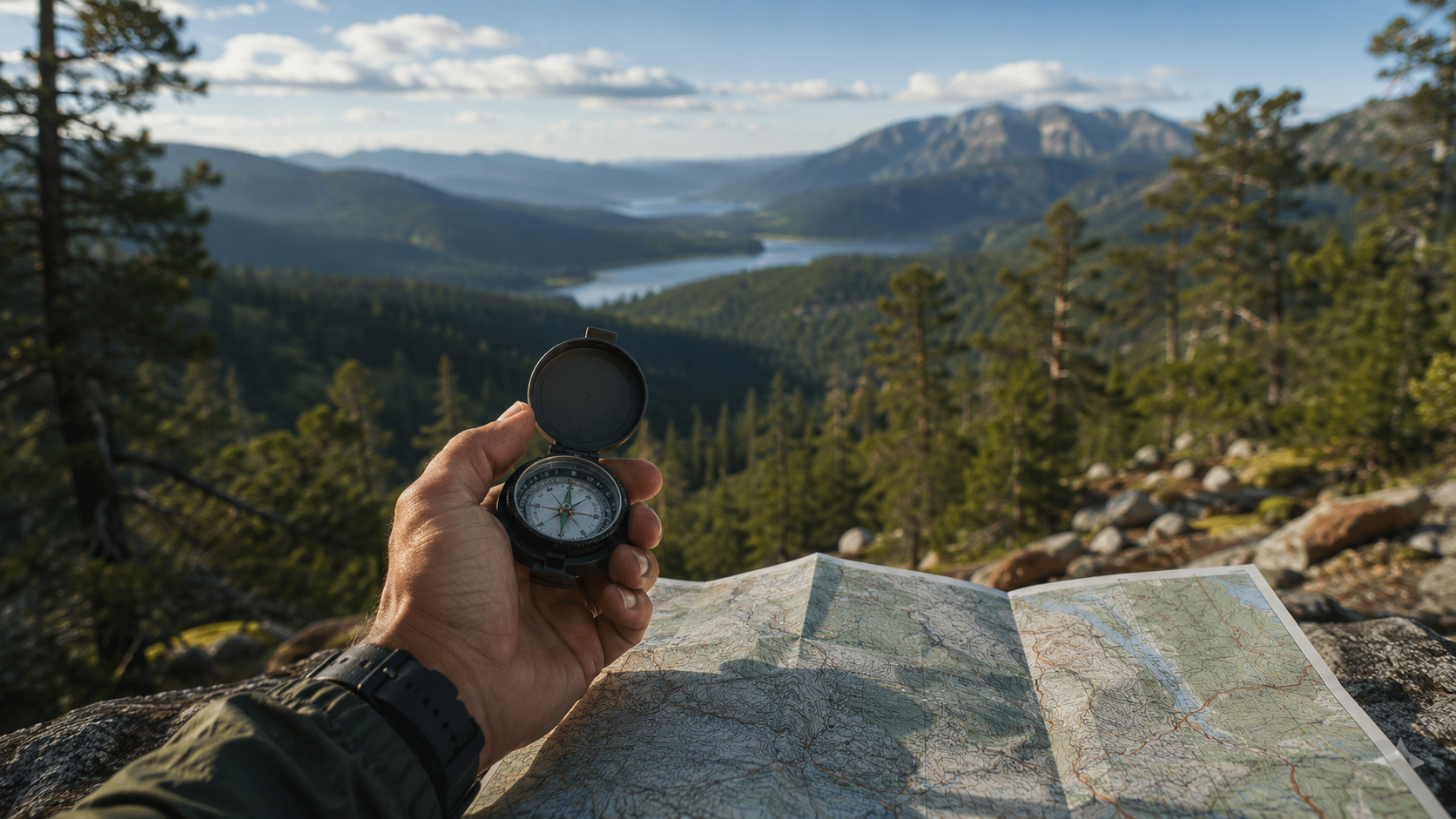
And none of them help if you cannot use them. A compass is only as good as your ability to pair it with a map, which is a learnable skill worth more than any feature. If you are starting out, our guide to navigating with a map and compass walks through taking and following a bearing.
Who should skip a dedicated compass?
If you hike only well-signed day trails and carry a phone with offline maps, a compass is a backup you may rarely touch. That is a defensible choice, not a reckless one, as long as you know your phone can die, freeze, or lose signal in a canyon.
The problem is leaning on GPS alone. Depending on the screen weakens the mental map you build of the terrain around you, so when the battery quits you are stuck without the instinct to recover. A compass and a paper map cost almost nothing in weight and never run out of power. If you want to weigh the tradeoffs, we compared the strengths of each approach in our look at handheld GPS units versus GPS watches, and a compass pairs well with either as the backup that always works.
For the record: carry both. The compass is not there to replace your GPS. It is there for the morning the GPS lets you down.
How to pick, by trip type
- First backpacking compass or marked trails: Suunto A-10. Learn the basics, spend little.
- Off-trail travel and serious map work: Suunto MC-2 or Silva Ranger 2.0. Adjustable declination and a sighting mirror earn their keep.
- Rough handling, night navigation, expect abuse: Cammenga lensatic, if you will put in the time to learn it.
- A cheap backup to stash in the pack: Eyeskey sighting compass. Good enough for a spare.
FAQ
How do I set declination on a compass?
On adjustable models like the MC-2 or Ranger, you use the small tool that clips to the lanyard to rotate the declination scale to your area's value, then leave it. Find the local figure printed on your topo map's margin or from a magnetic declination calculator, and reset it if you travel far east or west, since the value changes with location.
Do compasses need calibration or replacement over time?
A magnetic compass needs no calibration and no batteries. It can last decades. The two things that kill one are a broken mirror hinge and a large air bubble in the capsule from a failed seal. A tiny bubble is harmless. If the fluid leaks or the needle sticks, replace it.
Will a phone or metal gear mess up the reading?
Yes. Phones, trekking poles, belt buckles, watch bands, and car bodies all pull the needle off true. Take your bearing a step or two away from metal and electronics, hold the compass flat and level, and let the needle settle before you read it.
Is a wrist or thumb compass enough for backpacking?
For a rough sense of direction, yes. For real navigation, no. Wrist and thumb compasses cannot lay flat on a map to plot a bearing, which is the core job on unfamiliar terrain. Keep them as a quick-check tool and carry a baseplate for the actual work.
Does the compass need to match my hemisphere?
Standard compasses are balanced for a magnetic zone, and a needle balanced for the Northern Hemisphere can drag or tilt near the equator or in the south. If you hike across hemispheres, look for a global-needle model. For trips within North America, any of the picks above works fine.
