
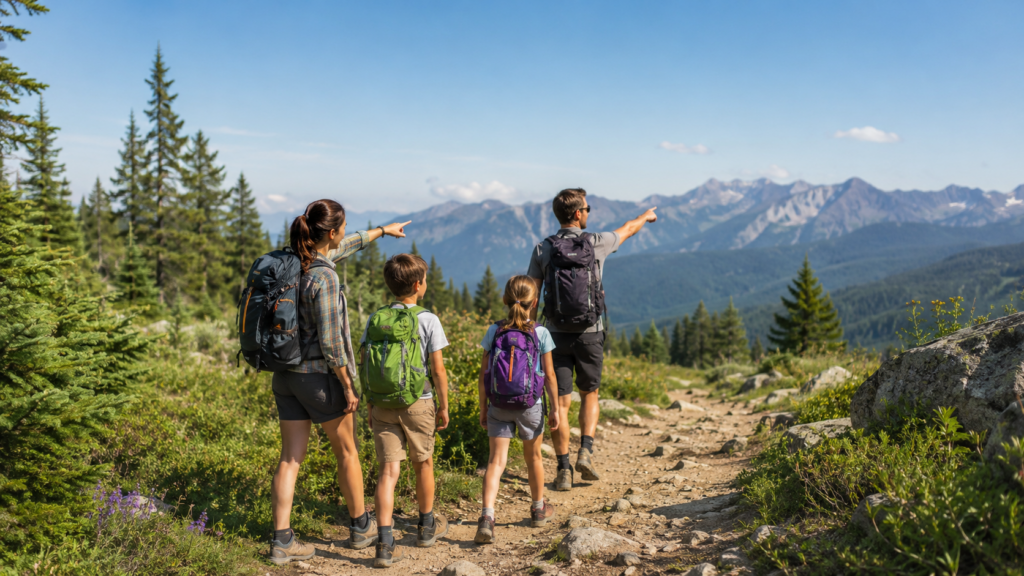
Family-friendly hiking gear means the small pile of things that keep kids fed, warm, dry, and willing to keep walking, not a closet of technical equipment scaled down and priced up. The gear that matters most is boring: a pack that fits the kid, shoes that drain and grip, snacks within reach, and enough layers to handle a cold wind at the turnaround. Buy the load-carrier and the footwear well, borrow or size-up the rest, and skip anything sold on the promise that it makes hiking effortless. Kids quit when they're cold, hungry, or their feet hurt, so that's where your money goes.
What counts as family-friendly hiking gear?
It's the stuff that solves the three reasons a kid bails on a hike: sore feet, cold or wet, and boredom that turns into a meltdown. Everything else is optional.
The honest split looks like this. Essential gear is what fixes a problem you can't walk off: footwear that fits, a way to carry water and snacks, rain and warmth layers, sun protection, and a small first-aid and navigation kit for the adult. Nice-to-have gear makes the day smoother: trekking poles for a kid who likes them, a bug net on a buggy trail, a lightweight kid daypack so they feel involved. Skip-it gear is anything technical a short trail doesn't demand, like a four-season shelter for a two-mile loop or a hydration system a five-year-old won't manage.
Age changes the math more than anything a hang tag says. A toddler who can't walk far means you carry them and their stuff. A grade-schooler can carry a light pack and pick their own snacks. A pre-teen wants gear that doesn't look like it's for a baby. Buy for the kid in front of you, not the one on the box.
Which gear is actually worth buying?
Here's the shortlist, with a plain call on each and where each one earns or loses its place.
| Gear | Who it suits | The call |
|---|---|---|
| Osprey Poco Plus child carrier | Toddlers, longer days, one adult carrying | Worth it if you'll use it 10-plus times |
| Salomon XA Pro 3D V8 (kids) | Active kids on real trail | Worth the money |
| Deuter Speed Lite Pro 30 | The adult carrying everyone's stuff | Worth it |
| Kid's own small daypack | Grade-schoolers who want to help | Keep it cheap |
| Trekking poles for kids | Steep or rocky trails only | Borrow or skip |
The Osprey Poco Plus is a framed child carrier built to haul a kid plus gear, and it's rated to carry up to 22 kilograms, or about 48.5 pounds, of child and cargo. That capacity is the point: it's not the number that sells you, it's whether your back forgives you after mile three. These carriers cost a few hundred dollars and are heavy and bulky empty. Worth it if you have a toddler and hike often. If you'll use it twice a year, borrow one or buy it used, because a carrier that lives in the garage is a false economy.
For kid footwear, the Salomon XA Pro 3D V8 is a trail runner, not a boot, and that's the right instinct for most children. Each pair weighs around 10 ounces, which reads as light feet that don't fight the trail. Light shoes that drain and grip beat stiff little boots for nearly every family hike, because kids don't carry heavy loads and don't need ankle armor for a smooth path. Boots make sense for snow, scree, or genuinely rough off-trail ground. The mistake is buying serious-looking boots for a park loop and watching a kid trudge because their feet are tired.
The carrying adult needs a real pack, because you end up hauling the water, the snacks, the shed layers, and the toy that was non-negotiable at the trailhead. The Deuter Speed Lite Pro 30 gives you 30 liters, which is enough for a family day hike without tempting you to pack the whole house. That volume is the sweet spot: big enough for layers and lunch, small enough that you don't fill it with things nobody uses.
How do you size a backpack for a kid?
Fit the pack to the child's torso, not their age, and load it light. A kid's pack should ride on the hips and shoulders without sagging past the low back, and it should hold their layer, their snack, and their water, nothing that makes them a mule.
A few plain rules that hold up on trail:
- Keep a young kid's loaded pack light enough that they forget it's there. If they're leaning forward or asking you to take it, it's too heavy.
- Look for a real hip belt on anything over a token size. Weight on the shoulders alone rubs and tires them fast.
- Chest strap matters more than volume for little kids. It keeps the shoulder straps from sliding off narrow shoulders.
- Let them carry things they care about. A kid who packed their own snack and a small toy argues less about walking.
The point of a kid's pack isn't capacity. It's ownership. A child who feels responsible for their little bag walks farther and complains less than one who's just being led. Our family day hiking checklist breaks down what actually belongs in it.
What gear do kids actually wear and use?
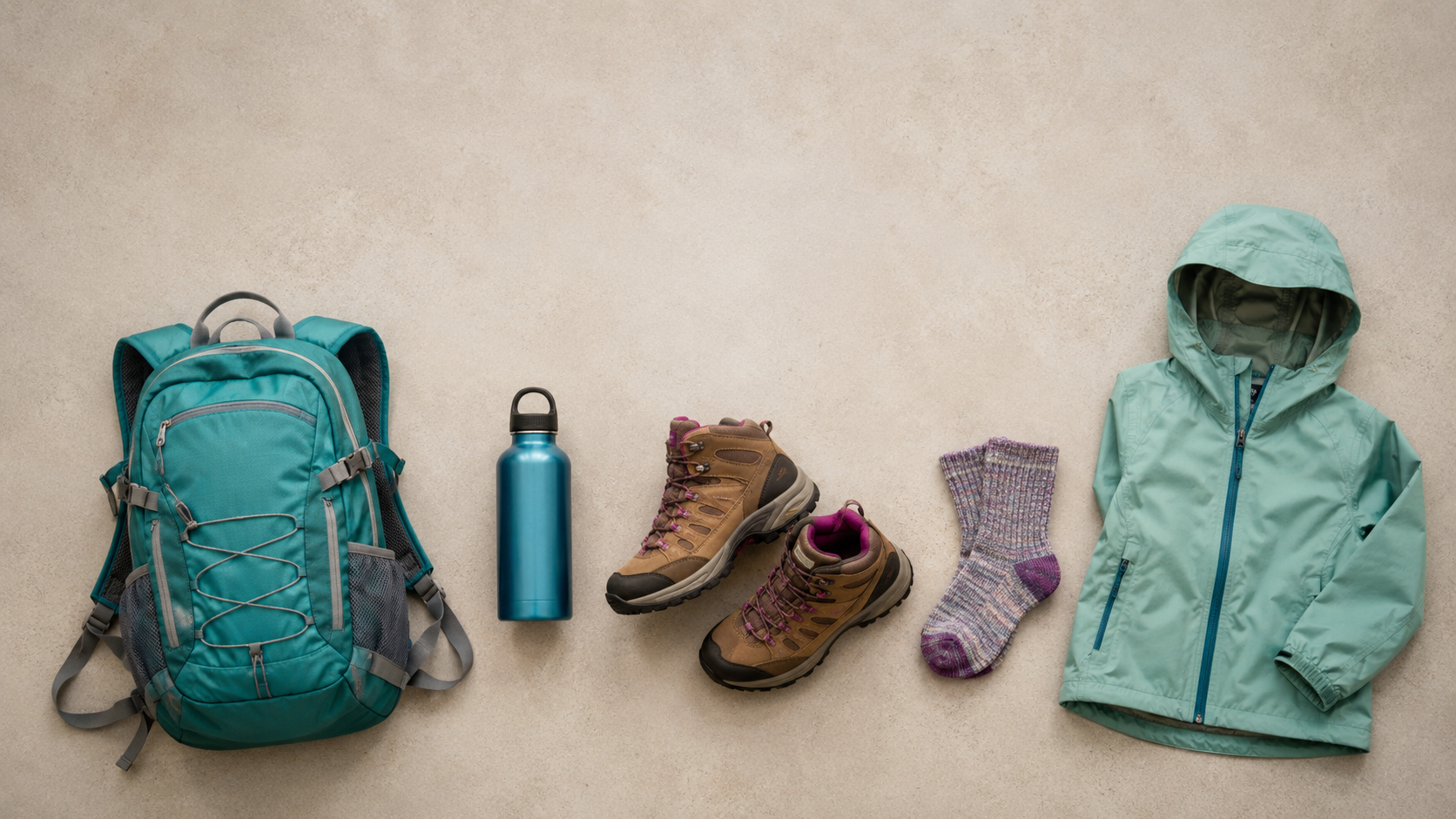
The gear that works is the gear a kid doesn't fight you on, which usually means it's comfortable, it's theirs, and it doesn't itch. Fancy features they can't operate get ignored by mile two.
Kids reliably use soft, non-scratchy layers, shoes that don't rub, a hat they picked, and snacks they can reach without stopping. They reliably ignore stiff rain jackets that feel like cardboard, hydration bladders they can't figure out, sunglasses that pinch, and anything an adult insisted was "the good one." Sweat management for kids is mostly about avoiding cotton that stays wet and choosing layers that dry fast, not lecturing a seven-year-old about fabric.
One quiet truth: a kid will wear the ugly fleece they chose over the technical jacket you chose, every time. Pick your battles on the safety items and let them win on color.
Where family hiking gear falls short
Most family gear fails at the boring edges, not in a dramatic blowout. It's the strap that rubs after mile 10, the "waterproof" jacket that wets out in steady rain, the carrier that's comfortable for twenty minutes and punishing for two hours.
Watch for a few specific letdowns. Kid rain jackets often trade real weather protection for a low price, so they soak through on a wet forest morning; test one under a hose before you trust it on trail. Cheap kid shoes tend to have thin soles that let every rock through, which turns a rocky descent into a whine-fest. Child carriers get sold on padding you feel in the store, not on how the load sits after a long water carry. And "kid-proof" durability claims usually mean the seams hold, not that the zippers survive a determined four-year-old.
None of this is a disaster. It's just the difference between what a hang tag promises and what shows up after a real trip. Plan for the failure point and you'll patch it before it ends the day.
Who should skip most of this?
If you hike a few gentle miles a couple of times a year, skip the specialized haul. You do not need a framed carrier, trail-runner kid shoes, or a 30-liter adult pack for an occasional flat loop with a stroller-age kid and a paved path.
Buy the specialized gear when the pattern justifies it: you hike often, your trails have real terrain, or you're carrying a kid who can't yet walk the distance. For everyone else, sneakers that already fit, a school backpack, a rain layer from the closet, and plenty of snacks cover a lot of ground. Good enough is genuinely good enough until you're out often enough to feel the gaps. When you do start going regularly, our guide on hiking with young kids and the safety essentials for hiking with kids fill in the non-gear parts.
For the safety kit itself, don't improvise. The adult carries navigation, first aid, extra water, and warmth, and the widely used framework for that is the Ten Essentials, which scales down fine for a day hike with kids.
FAQ
At what age can a kid carry their own pack?
Most kids can carry a very light pack around age three or four, but "carry" means a stuffed animal and a snack, not real weight. Through the early school years, keep the load token and put anything heavy on the adult. Let them graduate to water and their own layer when they stop complaining about the light version, which tells you they're ready for a little more.
Do kids need waterproof hiking shoes?
Usually no. Waterproof kid shoes trap sweat and stay wet inside once water gets over the collar, and kids find every puddle. Quick-draining, fast-drying shoes handle wet trails better than "waterproof" ones for most day hikes. Save the waterproofing for cold or snowy conditions where wet feet are a real safety problem, not just an annoyance.
How do I stop a kid's shoes from giving them blisters?
Start with fit, not socks. A too-roomy shoe lets the foot slide, and loose laces over the midfoot let the heel lift, which is where hot spots begin. Snug the laces, use socks that don't bunch, and if the same spot flares up every hike, tape it before you start walking. Trim their toenails too, since long nails jam on descents.
What should I not bother packing for a family day hike?
Skip the gear that solves problems a short trail doesn't have: a big shelter, a full cook kit, spare "just in case" outfits for everyone, and gadgets a kid can't operate. Overpacking punishes the adult who carries it and rarely gets used. Bring more snacks and water than you think, one warm layer each, and rain protection, then leave the rest in the car.
How do I keep a toddler happy in a carrier for a longer hike?
Break it up. Stop before they're miserable, not after, and let them walk short stretches so the carrier feels like a break instead of a cage. Snacks, shade, and a hat prevent most meltdowns, since a hot, hungry toddler in a carrier has no way to fix either problem themselves. Check straps and sun exposure at every stop, because they can't tell you a strap is digging in until they're already upset.
