
Did you know the leading cause of backcountry rescues isn’t a twisted ankle? It’s simply running out of daylight. That moment of “just a little farther” can turn a great day into a stressful scramble.
This is where a smart plan makes all the difference. A turnaround time is your pre-set deadline to head back. It’s the anchor for your entire adventure, accounting for fading light, shifting weather, and your group’s pace.
I’ve learned this boundary isn’t about quitting. It’s about building confidence. You trade risky guesswork for a controlled journey where you finish feeling strong, not exhausted.
Treat this decision as non-negotiable safety. It protects you from fatigue and the trail’s unpredictable nature. That single choice delivers immense value, transforming anxiety into freedom.
Key Takeaways
- A turnaround time is a fixed deadline to start your return, not a flexible suggestion.
- It is a critical safety boundary that accounts for daylight, weather, and energy.
- This plan transforms your outing from risky guesswork into a confident adventure.
- Experienced trekkers treat this time as a non-negotiable rule, not a goal to reach.
- Setting this limit before you start is a simple, teachable form of risk management.
- It ensures you return to the trailhead with reserve energy and daylight to spare.
- Smart planning is liberating, allowing you to explore boldly within safe limits.
Understanding a Smart Turnaround Strategy
A smart strategy isn’t about rigid rules. It’s about listening to your body and the path ahead.
You build true confidence by reading the signs before a small issue becomes a big problem.
Recognizing Your Limits and Conditions
Learn to tell normal soreness from real warning signs. This skill keeps you safe and in control.
Check this table to guide your thinking on the trail.
| Signal Type | What It Feels Like | Smart Response |
|---|---|---|
| Muscle Fatigue | General tiredness from a long day. | Take a short break, then continue. |
| Weather Shift | Unexpected wind, cold, or dark clouds rolling in. | Reassess your plan immediately. |
| Energy Drop | Persistent hunger, lightheadedness, or low mood. | Eat a snack and consider heading back. |
| Unfamiliar Terrain | Increasingly rocky, icy, or unclear path ahead. | Stop and evaluate risk versus your goal. |
When doubt creeps in, ask three questions. Why am I thinking about a turn around? What has changed since I started? Does going forward still match my original goal?
Learning from Real Hiker Experiences
One solo trekker tells a powerful story. Her goal was to explore a new trail. About halfway, several small things shifted.
Daylight was fading. Her snacks were low. The path got icy. She felt strong enough to continue.
Yet, she made the choice to head back. It was a confident decision based on the total conditions. She trusted her own judgment.
That moment built more confidence than reaching any summit. Real trail wisdom grows from these honest choices.
Factors Influencing Your Hiking Turnaround Decisions
Your turnaround decision hinges on three dynamic forces: the sun’s path, the sky’s mood, and the ground beneath your feet. Let’s break them down so you can build a plan that adapts.
Daylight, Weather, and Terrain Considerations
Always plan to finish your walk at least 60 minutes before sunset. Give yourself 90 minutes or more in winter or complex mountain terrain.
Weather creates predictable danger windows. Summer alpine thunderstorms often roll in after noon. A solid rule is to plan to be off any summit by noon, no matter what. A 3pm decision often leads to trouble.
Difficult ground slows you down. Add 10-30% to your estimated travel time for these common conditions.
| Terrain Type | Effect on Pace | Example |
|---|---|---|
| Rough Trail / Talus | Slow, careful footing required. | Rocky paths, scree fields. |
| Snow or Mud | Slippery, energy-sucking travel. | Spring snowfields, muddy passes. |
| Heavy Pack / Altitude | Reduced speed and stamina. | Multi-day gear, high-elevation climbs. |
| Route-Finding | Frequent stops to check the map. | Unmarked trails, bushwhacking. |
Impact of Group Pace and Energy Levels
The slowest person in your group sets the true pace. Recalculate your plan after the first mile if you’re moving slower than expected.
Honestly check energy levels all day. Fatigue on the return trip is when mistakes happen. If the trail is unfamiliar, the weather is shifting, or anyone is tired, a firm turn-back time is essential.
This is especially true for any family adventure. The group’s safety and enjoyment always come first.
Mastering Hiking Turnaround Time for Safe Hikes
Elevation gain, not just distance, is the hidden factor that dictates how long your journey will truly take. This section gives you the practical math to build a schedule you can trust.
Estimating Pace, Breaks, and Elevation Costs
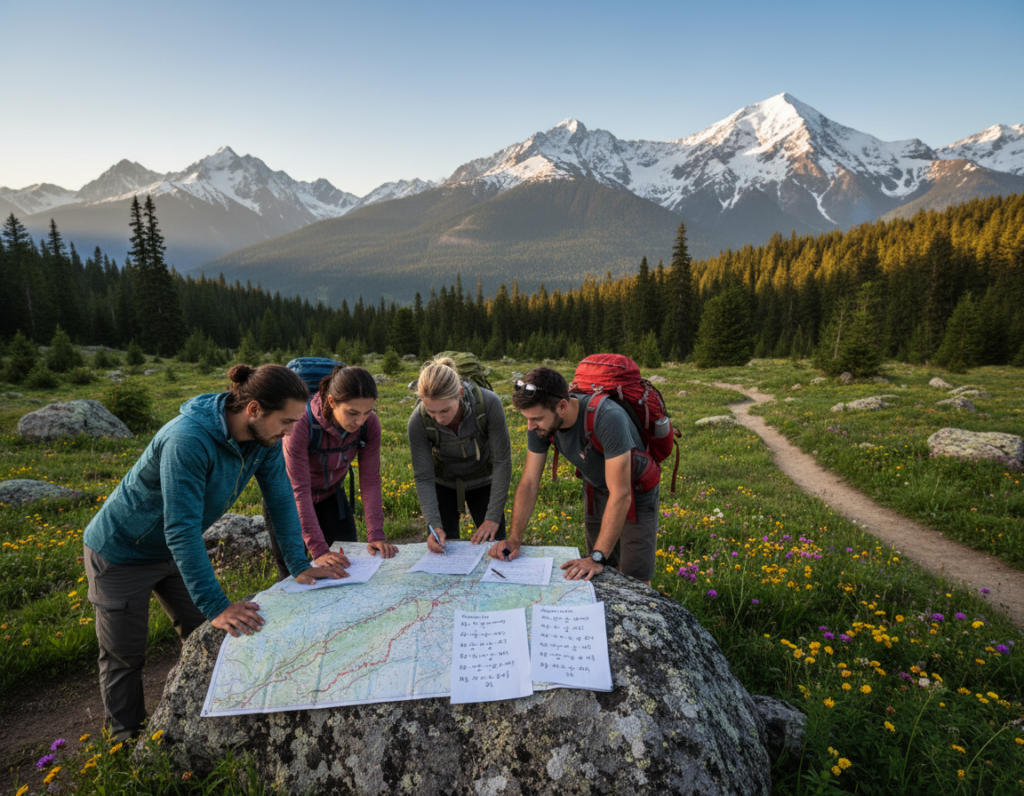
Your base moving pace on a trail is typically 2-3 miles per hour. Climbing is the biggest time driver. Proven formulas like Naismith’s Rule or Book Time calculate this cost for you.
Book Time adds 30 minutes for every 1,000 feet of ascent. Naismith’s Rule uses similar math. Both give you moving time only.
You must also budget for breaks. Expect 5 to 15 minutes per hour for water, snacks, and photos. These moments add up fast.
Always build a safety buffer of 20-30% into your plan. This cushion handles surprises like a rolled ankle or helping another trekker.
Learning to pace yourself is part of this smart calculation.
Applying Time-Estimation Formulas Effectively
Let’s use a real example. An 8-mile trek with 2,000 feet of gain yields about 5.5 hours of moving time using Book Time.
Add your breaks and safety buffer. This total determines your exact turnaround point.
Remember the “45% out, 55% back” rule. Your return often takes longer due to tired legs and careful navigation on the descent.
Adjust these numbers for tough terrain. Add 10-30% for snow, mud, or route-finding. Only subtract time on smooth, graded paths with a fit group.
Practical Techniques to Set Your Turnaround Point
Let’s translate those time estimates into a concrete action plan you can follow on the trail.
Your decision point must be clear and non-negotiable before you take the first step.
Using Fixed-Time and Percentage Rules
Start by setting your “must-be-back” time. Aim to return at least 60 minutes before sunset.
Two simple rules then give you your turn-around moment. Use whichever comes first.
| Rule | Calculation | When to Use | Key Benefit |
|---|---|---|---|
| Half-Time Rule | Start + 50% of total trip time | Standard day trips in good conditions | Simple, easy to remember |
| 45% Rule | Turn using 45% of your safe daylight | When descent may be slower or more cautious | Builds a larger safety buffer |
| Fixed-Time Override | A pre-set absolute deadline (e.g., noon) | Predictable hazard windows like afternoon storms | Removes temptation in risky conditions |
For example, on an 8-mile trek, the half-time rule might say 11:12 a.m. If a storm often rolls in by 1 p.m., your fixed override of noon is the law. You turn then, even if the summit is close.
Adjusting Plans Based on Changing Trail Conditions
Your initial plan is a guide, not a prison. New conditions demand a new calculation.
Check your pace after the first mile. If you’re slower, recalculate your turn-around point immediately.
Unexpected snow, mud, or group fatigue means moving your deadline earlier. Identify key decision spots, like a high pass, to reassess.
If the weather shifts or the path becomes tricky, your original time may no longer be safe. Adapting is a sign of smart trail wisdom.
Tools and Tips for Monitoring Your Hike>
Setting up a few simple alerts before you start lets you hike freely, knowing you’ll be notified when it’s time to head back. Modern tools handle the math, so you can focus on the views.
Utilizing Apps and Alerts for Time Tracking
Load your route into an app like HikeClock. Input the distance and elevation gain. The app uses your personal pace profile to do the calculations for you.
Set three critical alerts. They keep your entire journey on a safe schedule.
| Alert Name | When It Triggers | Why It Matters |
|---|---|---|
| First-Mile Pace Check | After your first mile on the trail | Verifies your speed. Adjusts your turnaround if you’re slow. |
| Turnaround Alert | At your pre-calculated turn point | Your non-negotiable signal to start your return. |
| Must-Be-Back Alert | Based on sunset minus your safety margin | Final deadline to be at the trailhead, auto-set by the app. |
Calibrate your personal pace. Time yourself on a known 1,000-foot climb and a 3-mile trail section. Store these numbers in the app for accurate future plans.
Essential Gear and Navigation Checks
Your tech needs backup. Always carry a reliable watch, a headlamp with fresh batteries, and a paper map.
Mark decision points on your map. Use obvious landmarks like a high pass or a major trail junction. Plan to check your time at each one.
For winter outings, daylight is short. Increase your safety buffer to 90-120 minutes before sunset. Add extra minutes for putting on layers or traction devices.
Share the plan with your people. Announce the turnaround deadline at the trailhead. This ensures everyone understands and owns the decision before the journey begins.
Conclusion
The most valuable skill you carry isn’t in your pack—it’s the confidence to make a smart choice when conditions shift.
Finishing your day safely is the real summit. This simple idea transforms risky ambition into a series of clear decisions.
Your plan is straightforward. Estimate your trip honestly. Protect your daylight with a firm must-be-back point. Use the half-time or 45% rule as your guide.
When that moment arrives, turn with confidence, not regret. You are investing in all your future adventures.
Experienced hikers know this truth. The decision to turn back on a mountain builds more self-trust than reaching any peak.
It feels challenging in the moment. Yet that temporary choice protects your group from a tired descent or sudden summer thunderstorms.
This discipline expands your world. You return healthy and eager for the next trail, whether in winter snow or under a summer sun.
Trust your judgment. The skills you practice today will serve you for years.
