
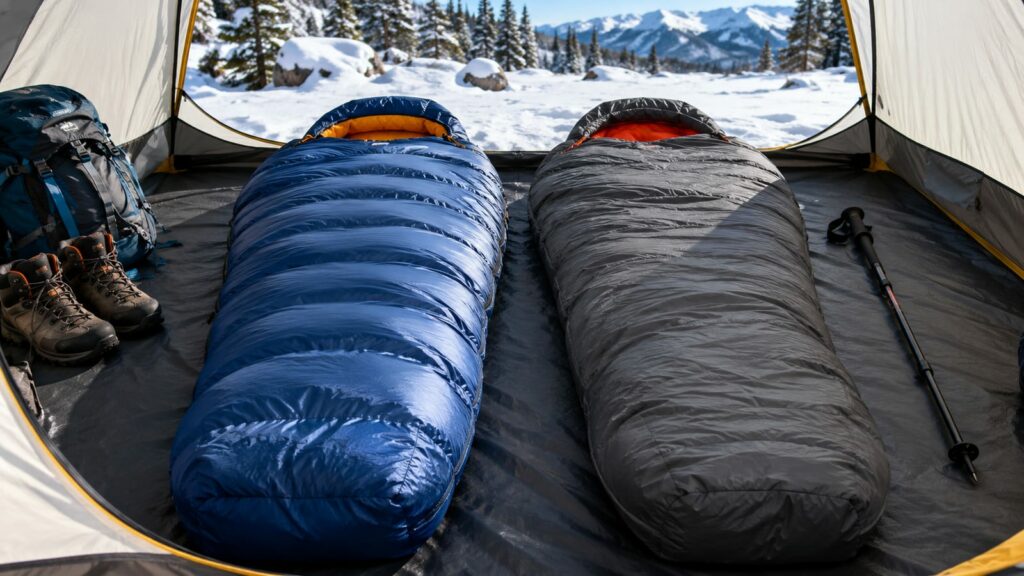
Most winter campers should buy a 0°F down mummy bag, pair it with a properly warm pad, and leave the expedition bags to people flying onto glaciers. For nights from the low 20s down to around zero, the best insulated sleeping bag for winter camping is something like the Therm-a-Rest Parsec 0F or Questar 0F. Both are warm enough and pack small enough for a snowshoe overnight, and neither costs polar-expedition money. Step up to a -20°F bag such as the Marmot Col -20 only if your real overnight lows sit well below zero.
That pick assumes you also bring dry base layers, a warm pad, and a tent that blocks wind. A winter bag is one part of a sleep system. Get the other parts wrong and even a deep-cold bag will leave you awake and shivering in the small hours.
Winter bags compared
These five are real winter bags, rated at 0°F or colder. Anything rated 15°F or warmer is a shoulder-season bag, no matter what list it lands on.
| Bag | Rating | What stands out | Who it suits | Call |
|---|---|---|---|---|
| Therm-a-Rest Parsec 0F/-18C | 0°F | Around $529; higher-fill down, lighter and smaller than the Questar | Most winter backpackers | Worth the money |
| Therm-a-Rest Questar 0F | 0°F | Same warmth target for less money, more bulk | Car campers, short hauls, first winter trips | Good enough |
| Feathered Friends Snowbunting EX 0°F Long | 0°F | Weather-resistant shell, long size | Tall sleepers, frosty single-wall tents | Worth it if you're tall |
| Marmot Col -20 | -20°F | Dedicated deep-cold bag | Northern winters, high winter camps | Keep it for real cold |
| Rab Expedition 1400 | -40°F | Huge, heavy, expedition-grade down | High peaks and polar trips | Skip unless you're going polar |
Which is the best insulated sleeping bag for winter camping?
For most people, a 0°F down mummy bag is the right winter bag. It handles nights from the low 20s to around zero on a warm pad, and it packs small enough to carry on your back. Buy colder only when your forecast lows actually sit below zero.
0°F bags for most winter trips
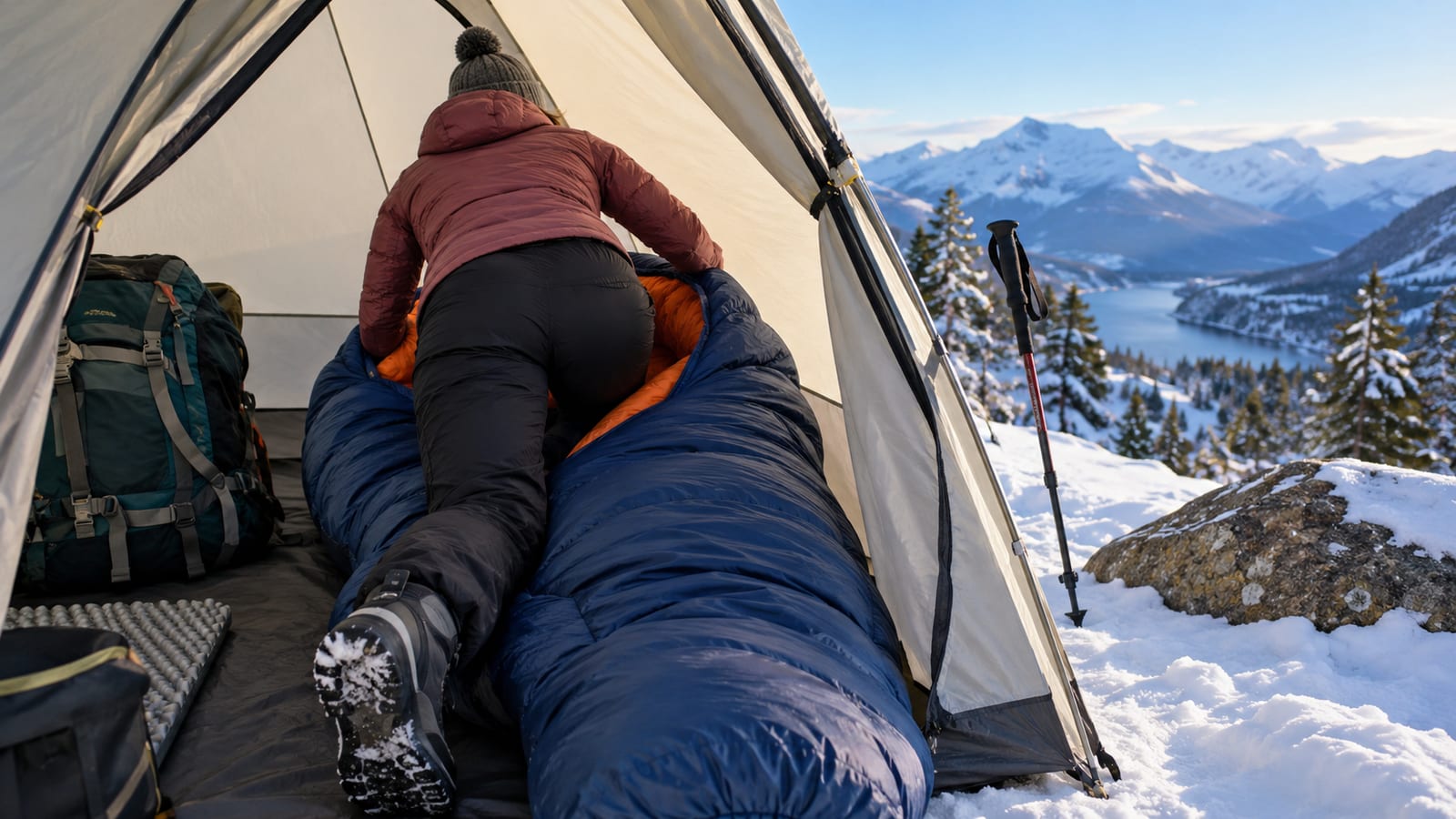
The Therm-a-Rest Parsec 0F/-18C is the bag to beat for winter backpacking. The price is steep. Still, the higher-fill down shows up as less weight on your back and more room in your pack, and that matters after mile 10 on a snowshoe approach.
One review roundup crowned the Therm-a-Rest Questar 0F the best warm bag for winter use. That's one test's label, and labels don't keep you warm. What the Questar really has going for it is price: it costs noticeably less than the Parsec and gets there with lower-fill down. As a result, you carry a bigger stuff sack and a bit more pack weight. For car camping, a short walk from the trailhead, or your first few winter nights, that trade is good enough.
The Feathered Friends Snowbunting EX 0°F Long earns its place for tall sleepers. A bag that's too short presses your feet into the footbox and your head into the hood, crushing the down right where you need it most. The EX shell also handles frost and tent drips better than a thin shell. That helps on still, cold nights when condensation rains off the fly. It costs real money, so it makes the most sense if you need the length.
When zero isn't cold enough
The Marmot Col -20 is the step up for places where the low regularly falls below zero. Think northern forests in January, high winter camps, or long trips where one bad night is a real problem. It's heavier, bulkier, and warmer than any 0°F bag here. However, on a typical lowland winter trip you'll spend half the night unzipping it and sweating into the down.
Rab designed the Rab Expedition 1400 for 8000 m peaks and polar trips, and the spec sheet reads like it. It carries 3 lb 2 oz of 850-fill European goose down with a fluorocarbon-free water-resistant finish. All in, it weighs 4 lb 9 oz and packs to about 19.7 by 11.8 inches. Rab puts its sleep limit at -40°F, which also happens to be -40°C, the one spot where the two scales agree.
It fits sleepers up to 76 inches tall, with 31.5 inches of shoulder room. That's a superb bag and a lot of down to haul for a January weekend at a state park.
Skip it unless a plane drops you off at the trailhead.
What do the temperature ratings mean?
Most serious bags are tested under the EN 13537 and ISO 23537 sleeping bag standards. The tests report these ratings:
- Comfort: the temperature where a cold sleeper stays comfortable lying relaxed.
- Limit: the temperature where a warm sleeper stays warm curled up in a ball for the night.
- Extreme: a survival rating. You'll probably live, and you won't enjoy it.
The number in a bag's name usually sits closer to the limit than the comfort rating. Brands don't always tell you which one they used. For example, Rab lists a "sleep limit," its own label for the figure.
If you sleep cold, buy by the comfort rating. Either way, pick a bag rated well below the coldest night you expect. Forecasts miss, and winter cold pools in valleys and campsites.
Down, fill power, and the moisture problem
Fill power measures how much a given amount of down lofts. Higher fill gives you the same warmth for less weight and bulk, which is why the Parsec beats the Questar on the scale. Meanwhile, lower fill gives you the same warmth for less money.
Down's weak spot in winter is moisture from your own body. You breathe and sweat all night, and in deep cold that moisture freezes inside the insulation. Over several nights, the bag slowly gets heavier and flatter. Water-resistant down finishes slow this down. They don't stop it.
So keep your face out of the bag, crack the hood vent, and drape the bag in the sun at lunch on multi-day trips. If you camp in wet, near-freezing conditions or stay out for a week, synthetic fill deserves a look. It's heavier for the warmth, but it holds up better damp. Our guide to down vs. synthetic sleeping bags covers that tradeoff in more detail.
Fit and shape matter more in winter
Winter bags should be mummy-shaped. A mummy has less dead air for your body to heat and a hood that cinches around your face. It usually adds a draft collar that seals heat in at the shoulders. Roomy, semi-rectangular shapes feel great in August and leak heat in January.
That said, a winter bag needs a little extra room inside. You'll want space for:
- Your water filter, because a frozen hollow-fiber filter is a dead filter
- Phone, headlamp, and batteries, which die fast in the cold
- Tomorrow's boot liners or socks, so you don't start the day on frozen ones
- A puffy jacket over your torso on the coldest nights
The balance is tricky. Too much space leaves cold pockets your body has to warm. Too little space compresses the loft from the inside. Lie in the bag wearing your winter layers before you buy, and size up the length if your feet touch the end.
Your pad does half the work
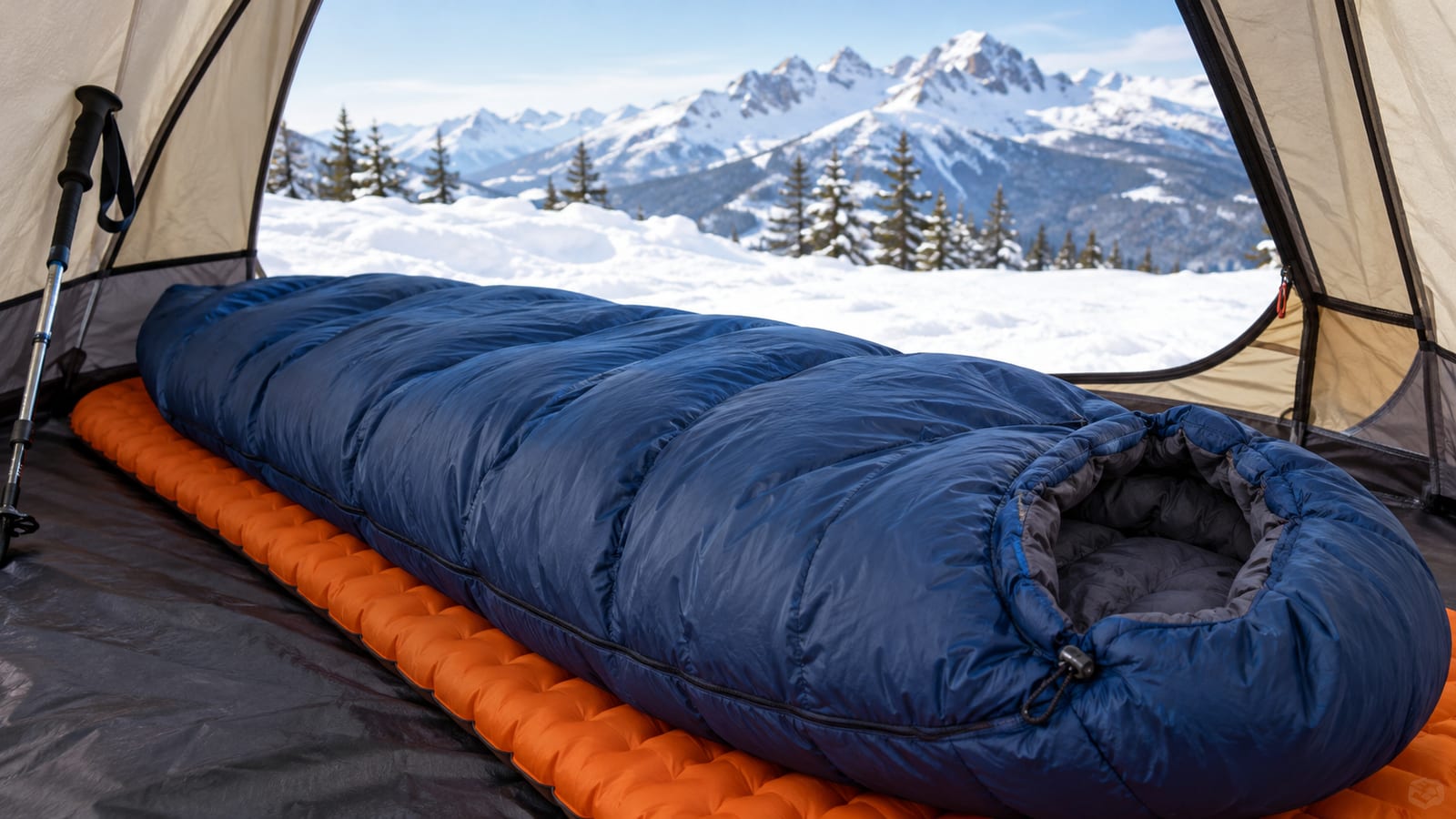
Bag insulation under you gets crushed flat by your body weight, so it barely helps. The pad is what stops frozen ground from pulling heat out of your back. A great bag on a summer pad sleeps cold, every time.
The common winter setup is a closed-cell foam pad under an insulated inflatable. That way, the foam still works if the air pad springs a leak at midnight. Our sleeping pads guide explains how to read pad warmth ratings and what to pair with a winter bag.
Your shelter matters too. Wind steals heat through any bag, and a tent built for snow load and storm pitch keeps that wind off you. Our comparison of four-season tents for extreme weather is the next read if your current tent is mesh-heavy.
Three-season bags that sneak onto winter lists
Plenty of "best sleeping bag" roundups rank bags rated between 15°F and 30°F. Those are good bags, and none of them is a winter bag.
- Sea to Summit Spark 15 ($549): light and packable, and it costs more than the Parsec while being far less warm. Skip it for winter.
- Nemo Disco 15 ($300): roomy and comfortable for side sleepers. That extra space is just more cold air in January.
- REI Co-op Radiant 20 ($209): a fair budget shoulder-season bag. Keep it for spring and fall.
- Marmot Trestles Elite Eco 20 ($189): a synthetic bag at a low price. It's heavy and bulky for its warmth, and it won't handle zero.
- Feathered Friends Swallow UL 20: a well-regarded three-season bag. Same verdict: wrong season.
You can stretch a three-season bag into early winter with a liner and a puffy. Even so, a 20°F bag on a 0°F night is a false economy. You'll pay in sleep, and possibly in safety.
Small habits that add warmth
A warm bag still needs a warm body inside it. These habits cost nothing and help on any bag:
- Eat something fatty before bed so your body has fuel to burn overnight.
- Change into dry base layers. Damp clothes from the day pull heat all night.
- Pee before you zip in, and again if you wake up needing to. Your body wastes heat on a full bladder.
- Fill a hard-sided bottle with hot water, seal the lid tight, and put it in the footbox.
- Pull the bag out of its stuff sack as soon as camp is set so the down has time to loft.
- Wear insulated pants or down booties on the coldest nights. Our guide to insulated hiking pants for cold weather helps if you're shopping.
FAQ
Can I put one three-season bag inside another instead of buying a winter bag?
It works in a pinch, and plenty of people get through their first cold trip this way. The outer bag has to be roomy enough that the inner one isn't squashed, or you lose loft. Two bags also weigh and pack bigger than one real winter bag, so this suits car camping better than backpacking.
Should I rent a winter bag before buying one?
Yes, if you're not sure you'll go more than once or twice a season. Renting lets you learn whether you sleep warm or cold, which is the most useful thing to know before spending several hundred dollars. Buy once you know the temperatures you actually camp in.
Is a vapor barrier liner worth carrying?
For multi-night trips well below zero, it can be. It keeps your body moisture from reaching the down, so the bag stays lofty longer. On a weekend trip, it mostly makes you feel clammy, so skip it.
How should I store a down winter bag at home?
Keep it loose in a large cotton or mesh storage sack, or hang it in a closet. Leaving it crammed in its stuff sack for months breaks down the loft over time. Wash it only when it's dirty or flat, using a down-specific soap, and dry it fully on low heat with a few clean tennis balls.
